

Review by Melissa
Editor’s Note: We publish this review in the lead-up to Courage Day, observed annually on 15 November. In New Zealand, the New Zealand Society of Authors (PEN NZ Inc) marks PEN International’s Day of the Imprisoned Writer as “Courage Day”. The name honours New Zealand writer James Courage (along with his grandmother, author Sarah Courage) to recognise the bravery of writers who face censorship, persecution, harassment, or imprisonment for exercising free speech.
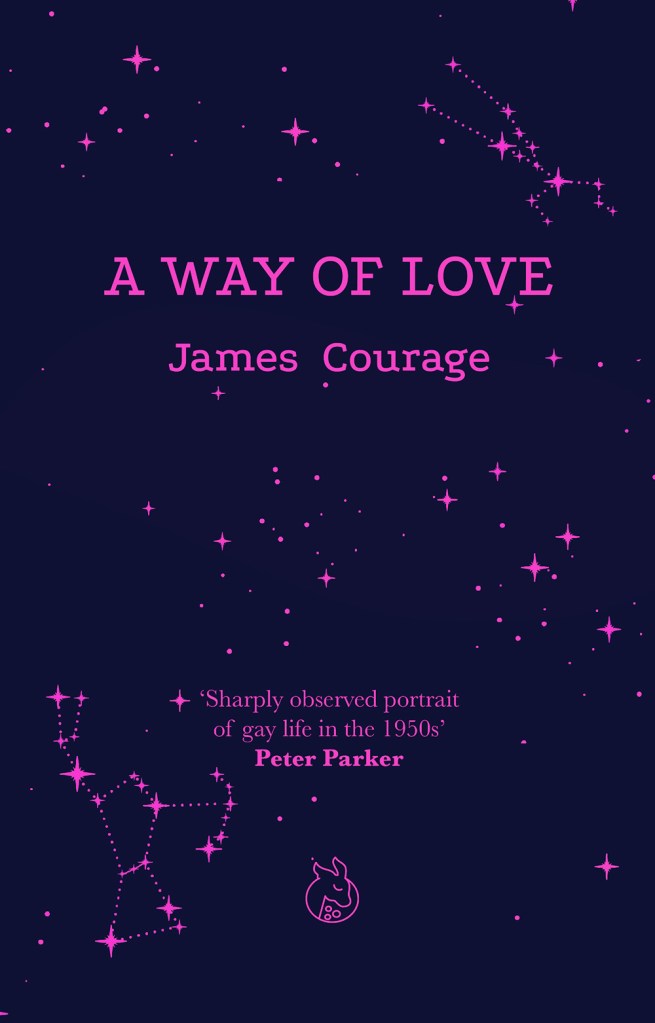
Long before queer literature was accepted as mainstream, New Zealand expatriate James Courage laid bare the raw, fragile intersections of desire, class, and survival in his daring 1959 novel, A Way of Love.
From its opening pages, the book plunges readers into the deep-seated loneliness of characters like Bruce Quantock and Philip Dill, binding their isolation directly to sharp economic stratification. Mid-century capitalism and draconian criminalisation act as mutually reinforcing catalysts that drive the profound isolation and tragic compromises of its characters. Through the tense dynamic between Bruce—whose professional material comfort serves as a defensive fortification—and Philip, whose acute class anxiety has a profound impact on his health, Courage demonstrates how the private sphere is co-opted to mimic oppressive societal norms. Having clawed his way from a provincial working-class background in Cornwall to a clerkship in London, Philip’s fierce independence is a desperate shield against being perceived as a “kept” man.
Throughout the narrative, intimacy and economic dependence remain inextricably linked. Bruce views Philip as “partly my creation” while funding his career, setting the stage for Philip’s internal torment: he fears he doesn’t measure up to his own internalised standards of manhood, independence, and respectability. The heartbreaking climax of this pressure sees Philip abandon a long-term loving relationship with Bruce, chasing the hollow promise of a socially acceptable life that might grant him status and confidence.
This class stratification taints the wider gay subculture depicted in the novel. Characters are trapped in rigid economic strata, ranging from Etonian export managers and barristers down to miners’ sons forced to lose their regional accents, while working-class men are frequently reduced to mere erotic supply. Even domestic structures echo oppressive societal norms: Bruce’s housekeeper, Rose, mirrors traditional servitude, while couples like Wallace and Martin mimic bourgeois marriage. Without naming it, Courage brilliantly exposes how capitalism isolates the private sphere, forcing queer men to construct privatised, miniature nuclear families simply to claw back a shred of security.
When Bruce meets up with an old friend, Horace, they end up having a heart-to-heart conversation about the choices his friend has made:
> “If only I’d realized my true inclinations earlier — if only I’d faced them — what contortions of conscience I might have avoided, these last few years.’
> ‘Would you, Horace? I wonder.’
> ‘Would I? You ask me such a question! I’m a middle-aged man and I’m torn in pieces.’ He drew on his cigar. ‘You’re a free agent, Bruce; you’ve never committed the indiscretion of marrying, the folly of it for people of our persuasion. I’m trapped. I feel an impostor in front of my wife, who treats me with love and has no suspicion, poor soul, that I am not as other men. To her I’m simply a husband much like the husbands of other women. A trifle more sensitive than most perhaps, a trifle wistful in the mornings, and rather too apt to be fastidious about my clothes and my body, but still — not obviously different. I have none of those stigmata you and I deprecate in others and which even a blind wife might question. No, Gertrude does not suspect me, thank God.’ Horace glanced towards the back of the house and shook his head. ‘Still, how did my life come to turn out as it has? How, how?”
Such a retreat into the private sphere wasn’t just a lifestyle choice; it was a desperate survival strategy forged under the anvil of severe criminalisation. Operating under draconian laws like the Offences against the Person Act 1861, queer men lived under the constant, suffocating dread of blackmail, public exposure, and violent hostility. Because public gathering was perilous, the novel charts fragmented, clandestine survival strategies depicted in settings ranging from underground flat parties to coded encounters in concert halls, where characters constantly tread the razor’s edge between discretion and discovery.
Courage’s own relationship with his homeland was equally fraught. Leaving New Zealand for Oxford in 1922 and returning only once (in 1933), he found himself marginalised on both sides of the world. When A Way of Love finally reached New Zealand, the state summarily banned it. Local literary elites were predictably vicious; in June 1959, academic M.K. Joseph penned an infamously dismissive critique in the journal Landfall, sneeringly writing off homosexuality as a mere “pretension” and “doomed of itself to dissatisfaction”.
Following Courage’s death in 1963, his executors and relatives clamped down with decades-long embargoes on his personal papers and diaries—even blocking his inclusion in a 1997 anthology of gay New Zealand writing.
Yet truth has a way of outliving its censors. The eventual lifting of those embargoes led to the landmark 2021 publication of The James Courage Diaries, edited by Chris Brickell. Today, decades after being suppressed, banned, and nearly forgotten in Aotearoa, A Way of Love has undergone a brilliant international reappraisal, cementing James Courage’s legacy as a pioneering voice of mid-century queer literature who helped pave the way for others to live their lives in a more courageous, authentic way.


Leave a Reply