

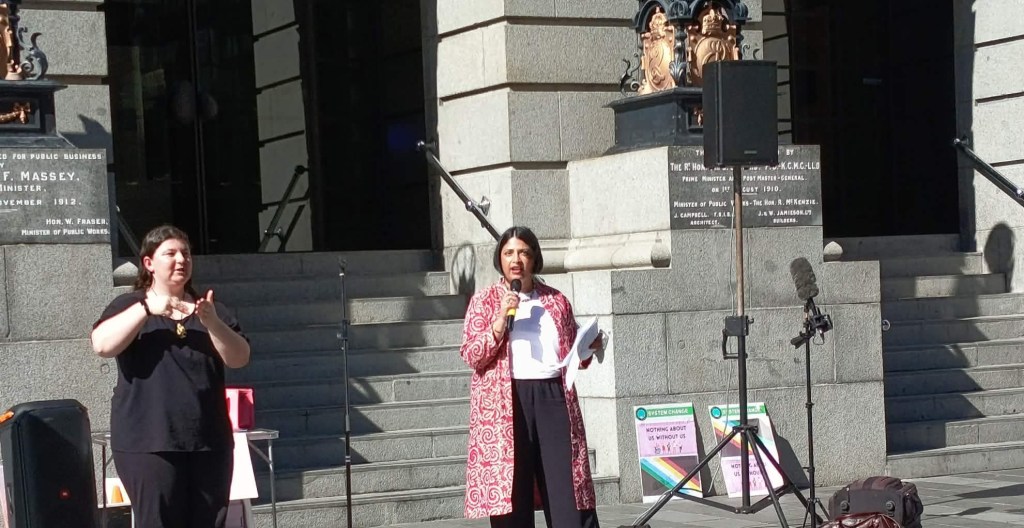
A Policy Programme for Disability Rights and Access
Housing · Income Support · Transport · Workforce · Emergency Preparedness · Rights
Introduction
Seventeen percent of New Zealanders are disabled. Add to that everyone who has experienced restricted access to the world, through pregnancy, raising young children, ageing, illness, or injury and it becomes clear that access is not a minority issue. It is a whole-of-society issue.
More than 35,000 households with a disabled family member currently live in material hardship, driven not by income or education but by disability itself. Fifty thousand more children are going without than three years ago. These outcomes are the product of policy choices — which means they can be changed by different policy choices.
This programme sets out what a government committed to disability justice would do, organised into six pillars: housing, income support, transport, workforce, emergency preparedness, and rights enforcement.
1. Housing
Goal: Every disabled person and older adult has access to a safe, accessible, and independent home.
- Build at least 4,000 new Kāinga Ora homes per year to universal design standards.
- Require all new public buildings to meet the same universal design standard as a condition of consent and funding.
- Direct a share of new-build accessible housing toward the needs of older people ageing in place, supporting independence alongside safety.
- Establish a public reporting mechanism (e.g. through Kāinga Ora’s annual report) tracking the number and proportion of accessible homes delivered against target.
2. Income Support and Dignity
Goal: Disability income support is unconditional, adequate, and free of surveillance.
- Remove abatement rates and partner income testing from the Supported Living Payment.
- Pay the Supported Living Payment on the same no-conditions basis as New Zealand Superannuation — without any reapplication hurdles.
- Reverse recent trends toward adding eligibility conditions and compliance requirements to disability benefits.
3. Transport
Goal: Disabled people can move freely, on their own schedule, without cost as a barrier.
- Deliver free, frequent, and accessible public transport.
- Provide free fares for Total Mobility Card holders and their support people across buses, trains, and ferries.
- Fund door-to-door transport services, available day or night, for those who need them.
4. Workforce
Goal: The people who provide care and education are paid and resourced adequately.
- Deliver real (above-inflation) pay increases for disability support workers and healthcare professionals.
- Fund a teacher aide in every classroom for every child who needs one, as an ongoing entitlement rather than a discretionary grant.
- Guarantee disabled workers the same minimum wage and pay rates as all other workers, with no exceptions, exemptions, or reduced-rate permits based on disability.
5. Emergency Preparedness and Climate Resilience
Goal: Disabled people are protected first, not last, when disaster strikes.
- Require accessible emergency communications and accessible emergency/evacuation buildings as standard, not exception.
- Provide targeted support before, during, and after emergencies for disabled people and their households.
- Honour Te Tiriti o Waitangi in every emergency management plan.
- Fund disabled people, marae, and local communities directly to lead their own emergency preparedness planning.
- Require government agencies to work closely with, and adequately fund, Disabled People’s Organisations in emergency planning and recovery.
- Ensure Tāngata Whaikaha are included in emergency planning in ways that reflect Te Tiriti o Waitangi.
6. Rights Framework
This programme is not a discretionary wish list — it is the minimum required by existing international commitments:
- The UN Convention on the Rights of Persons with Disabilities (UNCRPD).
- The International Covenant on Economic, Social and Cultural Rights (ICESCR), which requires governments to use the maximum available resources to progressively realise the right to health care, housing, food, water, and an adequate standard of living — obligations that do not lapse during emergencies.
Implementation principle: Governments must do everything within available resources to protect access to health care, housing, food, water, and a decent standard of living during emergencies, with those most at risk protected first.
Summary Table
| Pillar | Key Commitment |
|---|---|
| Housing | 4,000+ universal-design Kāinga Ora homes/year; all new public buildings to same standard |
| Income Support | No means testing, no abatements, no partner income test on the Supported Living Payment |
| Transport | Free, frequent public transport; free Total Mobility fares; funded door-to-door services |
| Workforce | Real pay rises for support workers and health professionals; funded teacher aide for every child who needs one, equal pay for disabled workers |
| Emergency Preparedness | Accessible communications and buildings; Te Tiriti-based planning; direct funding to disabled-led and community-led preparedness |
| Rights Framework | Grounded in UNCRPD and ICESCR obligations |


Leave a Reply