

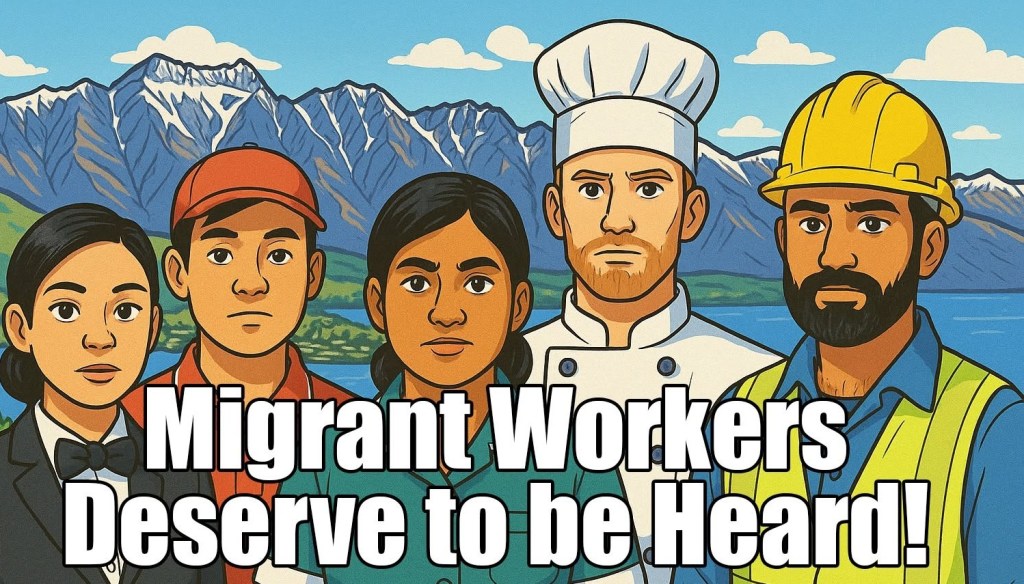
The global rise of the far right and recent scenes of anti-migrant violence in the UK have prompted many on the Left to ask: how do we mobilise to stop this happening here? Socialist Aotearoa spoke with Unite organiser Simon Edmunds to explore how the union is building solidarity between migrant and non-migrant workers in Otago and Southland.
Can you explain what the migrant worker situation is in the areas you cover? What sectors are most reliant on migrant labour?
Unite is the hospitality union, but I also work for the posties’ union down here. In Otago – especially the Queenstown Lakes region – because of the cost of living, it’s unaffordable for many Kiwi workers to live in these areas. So businesses are absolutely reliant on migrant labour to keep the entire economy afloat.
In Queenstown Lakes, migrants make up around 98% of hospitality workers, in hotels it’s probably 95%, and in retail it’s 50 to 60%. But then there are other sectors where it’s really high as well – like the construction industry, a sector that’s growing fast here. In elderly care there’s a huge reliance on migrant workers, and among nurses. I was helping the nurses’ organisation with their strikes down here last year, and there were lots of Filipino migrant workers on that picket line. In Southland, large numbers of dairy farm workers are migrants. It spreads beyond this concentration in Queenstown Lakes. Balclutha, Gore, Riverton and Invercargill are having increasing levels of immigration. These temporary migrant workers are not just – and this is crucial – filling skill gaps but actually providing what Marx called that reserve army of labour. That downwards pressure on wages and conditions, that ability of people to take strike action.
Where are they coming from mainly?
In our region, the two biggest groups would be Filipino workers and Indian workers, There’s also significant numbers of Sri Lankans, Chinese, South Americans.
What are the main issues facing these migrant workers? Specifically, what does the Accredited Employer Work Visa (AEWV), which ties immigrants to one employer, mean for them?
First and foremost, it’s fear. When your employer has the power to remove you from the country, say if your employment contract falls over because you are fired, for example, you not only lose your job, you lose the house you are paying rent on, your whole visa automatically gets cancelled, and you are deported. So employers have a huge amount of power over their employees, and that is reflected in this culture of fear.
The other aspect of the AEWV visa is that most of these workers get an initial year or two years but then are reliant on an extension year or, in higher skill level cases, an extension two years. That is reliant on the employer offering them that extension and then approving it. So keeping in the good books of your employer, hoping for that extension is absolutely in people’s minds. It is a huge pressure. There is an incredible amount of fear in workplaces about being seen to be a troublemaker. You don’t want to complain about anything that happens at work, you don’t want to say no to any shifts that are offered, or to any duties you are told to do. You certainly don’t want to join a union. You don’t want to be seen talking to other workers about what your rights are or complaining about the pay rates. You don’t want to turn down those graveyard shifts. You basically want to be a yes person, keep your head down, don’t complain and hope that you will be able to last out the time, and send money home to your family. It’s an incredibly unbalanced situation.
It’s bad enough being a worker in a high unemployment economy, when you’re so terrified of losing your job you don’t make a fuss. It sounds like that, only multiplied.
Absolutely. And as socialists we have some analysis that’s a bit different. It’s similar to the way high unemployment is used by capitalism to suppress workers’ agency. A good way to think about migrant workers, particularly on this AEWV visa, is that while the unemployed in New Zealand are the class reserve army of labour, the migrants are this global reserve army of labour that is being used in exactly the same way.
You’ve talked before about resentment sometimes towards migrants from non-migrant workers… what is driving that? Is it because they are seen to be kowtowing to the bosses, or is it a perception that ‘they are taking our jobs’?
It’s a combination of those two. The most important reaction is based in some reality. It’s not just racism existing because of ultra nationalist ideas or inherently racist ideas. If you are a fast-food worker in Gore and you are on a contract that keeps you precarious, which is absolutely the model of fast-food companies, you might get 20 guaranteed hours. When it’s busy the boss will give you more hours, if not they’ll cut you back. So you are desperate for more shifts to pay your bills, right? Then instead of the boss offering you additional hours, all of a sudden a migrant worker turns up. This migrant worker has been sent down from Queenstown from the labour hire company that has brought them into the country. They are available in a far wider way than you are. For Kiwi workers who sign an employment contract in fast food, you have available work days and times that you sign up to, that you must be rostered under. For most migrant workers under the AEWV, before they even get the visa, they have agreed with the employer that they will be available 24/7. That means any time of the day, any day of the week.
So not only is this person coming in and seeming like they are taking hours that you would take, but the employer seems to like them more because they don’t complain, they are not unionised, they can do all the shit work. That reaction towards them can very easily feed into racism. When it’s just one person coming in, probably not. But what we’re seeing is large groups of migrants moving into workplaces and the non-migrant workers are looking at the 10 or 20 Filipinos who have just turned up and you can see how racism festers. They might be speaking a different language that you can’t understand at your site, which exacerbates the issue, they might look different to what people look down south, where it’s a homogenously white culture. They are more easily identifiable. So we are seeing this dangerous growth in racism as a response, which is extremely concerning to the union movement and to socialists obviously.
As a union organiser this must be alarming and frustrating, especially given what’s happening overseas with attacks on migrants. What strategies are you using to talk to migrant workers and non-migrant workers, to cut through the fear and resentment, to get them to stand alongside one another?
With non-migrant workers, the key arguments we need to be making – and this is where socialists can put forward an argument no one else really makes – is that in order for the working class to have more power and leverage, there has to be solidarity across the working class. And racism, the attempts by employers to divide the power of the working class through juicing migration, through high unemployment, these are things that reduce the power of all workers.
The argument we make is for solidarity. That by bringing migrants into the union, into the communities that exist at work sites, it means workers as a group are able to operate collectively far more effectively than if they are siloed off into these separate communities. Because when it comes to using that collective power – from asking for a small change in the workplace right through to the ability to take strike action – all of those industrial strengths are hindered by a lack of solidarity.
These are simple arguments to make to non-migrant workers, but it is so important that we are making them. Because you know, as you referenced about overseas, what the other argument is. It’s ‘get rid of migrants, stop migration, blame migrants, deport them, burn them out of their houses, put them in ICE detention camps’. It’s fascism.
What about migrant workers – how do you help them overcome their fear and their reluctance to join the union?
With migrant workers the arguments are more difficult, but they are possible. One of the barriers has been that in some of these countries there are issues with the unions that you have to acknowledge and talk about. For example, in the Philippines, most of the unions are linked directly to the Communist party of the Philippines and are extremely militant. Being a union member means you are identified absolutely as a trouble-making communist. You can be fired, you might be beaten up, you are almost certainly going to be put on the front lines against armed police out on strikes and protests. While we don’t want to say New Zealand unions aren’t militant, what we can say is that we are independent. We’re not linked to any political party, and they’re not going to be chucked in jail because we are throwing them against armed police in a 100,000 march next week. Also, it’s illegal to fire someone for being a union member in NZ.
Have you had any success in recruiting migrants to the union, and if so how?
Yes, it’s generally come through making those arguments and knowing your stuff. Migrant workers will respect you if you understand these issues and acknowledge that culture of fear. Acknowledge all the extra pressures on them. Successfully helping a migrant worker on site with a problem they’ve had can lead to the whole group of migrant workers connected to them joining the union. So being able to prove through action that the union will be on their side has been crucial for breaking through. In Queenstown, in Invercargill, in Gore, we’ve had those breakthroughs where some minor piece of case work has proven our value. Then the group of migrant workers has met offsite to talk to one another and all of a sudden all of them will join the union. So it absolutely does happen but not in the same way that Kiwi workers might join a union, which is through a recruitment conversation. It’s usually a collective decision by a migrant community.
Isn’t there a Catch 22, that migrant workers won’t join the union unless they can see you will help them, but you can only act on their behalf once they have joined?
To some extent we do have to suck up case work that is unpaid in order to breach that. For example, our union has just started bi-weekly employment advocacy meetings that are free for any migrant workers in Queenstown Lakes.
Unions on the whole in the private sector have very limited resources. So all unions have a rule that if someone is not a member and then joins with a pre-existing problem, we can’t help them. Say if someone joins the union and rings that night to say “I have got a disciplinary, I’m on a final written warning because of these things that have happened over the last three months, can you help?” generally our answer is no. We’ll say “We will help you with things going forward but our members who are paying for the union to exist can’t pay for someone to get access to legal support when they haven’t contributed.”
We have to bend that a bit when it comes to migrant workers because that is what normally happens. Someone will ring you and it will be a problem that is pre-existing, so we go to our national secretary and ask for the ability to do that. She makes the decision and then we will possibly go ahead. But it’s usually for those organising reasons, ie if we do this, this will be potentially the positive outcome. We are the poorest union by far, so if we can do it anyone can.
Last week you spoke at the meeting in Auckland, where unions and community groups came together to discuss creating a united front to combat migrant exploitation and racist attacks. And to fight for law change on a range of issues affecting migrant workers, like changing the stand-down period once a visa has expired and scrapping the AEWF visa. Can you speak to that, that need for a united front approach?
It’s crucial to build a new united front around these issues. Again, it’s a vital role that socialists can play because this is very much a socialist tactic, to have this broad approach that crystallises around particular issues, around legislative change.
It was good to see a wide range of unions involved at the meeting. Migrante, the Filipino workers group; the Union Network of Migrants (UNEMIG); Unite; Workers First union; Etu and a whole variety of community groups like the Migrant Workers Association (MWA).
I think that is very important to, rather than just focusing on the work sites, express a bit of community power and put pressure on the government for legislative change.
Through a similar approach, back in 2021 we achieved a significant win – we got residency for over 200,000 workers in something called RV21 (click here for video link) That was absolutely driven by groups like Unite and the MWA, and that is what we are wanting to do again. Because pathways to residency are a key aspect of this.
If you stop migrants from integrating into a community, it is much easier to scapegoat them, to treat them as the ‘other’, to have racist ideas about them. And that lack of a pathway for residency, that stand-down period where they have to leave New Zealand for a year [before they can apply for a new visa], where their kids have to leave school, to leave the country that is their country, that is a way of isolating them from other working class people. So, demands around bringing them into our communities and making them part of our communities are absolutely crucial to solidarity. It’s not just the decoupling of the visa from one employer, it’s also these other aspects that we see as really important in building that solidarity.


Leave a Reply