

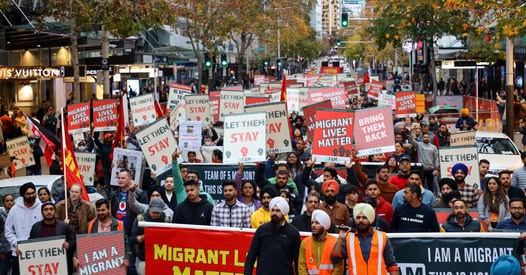
SA spoke to Anu Kaloti, a founding member and current president of Migrant Workers Association, about the multiple issues facing immigrant labour in New Zealand – and how socialists can use this election year to fight back against migrant exploitation.
Can you explain what your organisation does?
MWA was specifically formed to deal with exploitation of migrants who are on temporary visas with work rights in NZ. Also to deal with the symptoms of exploitation. That means providing pastoral care for the victims, support for their employment matters and immigrant matters and at the same time trying to get better immigration policy so we don’t have exploitation in the first place.
You’ve talked before about how the Accredited Employer Work Visa (AEWV) is to blame for much of the poor treatment of migrant workers. What is it, and what role does it play in exacerbating exploitation?
The AEWV was brought in in July 2022, aligned with our borders re-opening, the justification being that we needed to import labour to kickstart the economy. Before that, we’d had bonded visas for quite some time – there was the essential skills visa. I can remember a good two decades where we’ve had bondage of migrants to single employers.
With the AEWV, during the consultation period from 2018 to the next two or three years, what was touted was additional checks and balances. Until the AEWV was introduced the entire onus was on the visa applicant to prove they were credible and bona fide applicants, suitable for the role, that it wasn’t a fake scam job but genuine employment. The premise was they were going to bring in a three-pronged approach. That a) the employer would have to meet certain benchmarks and be registered as an accredited employer b) the employer had a responsibility to look for NZ workers; if they couldn’t find any, they could get the job approved by Immigration NZ and offer it to a migrant worker and c) the migrant worker applied for the visa. This is what was promised, plenty of checks and balances to minimise exploitation.
But when they were taking submissions for the AEWV, unions, workers associations, CBA and other social justice organisations overwhelmingly submitted against. On the surface, the checks and balances looked good, but the accredited employer work visa maintained the bondage of migrant workers to single employers – just like the work visas it was going to replace. It was also obvious that the department did not have sufficient resources to perform the proposed checks and there would be too much reliance on a high trust model for the first two parts of the process – the employer accreditation itself and the job approval.
But they didn’t take the opposition to the visa into account.
Fast-forward to 2022 when the borders re-opened and there were hardly any checks in place. Some junior staff at Immigration NZ whistleblew around the end of 2023/early 2024 saying the senior managers had told them to ignore a lot of checks and balances that were already in place before the visa came in, and they had to just “approve, approve” because we needed to get the economy back to pre-Covid levels.
That led to a review into the processing of the whole AEWV, not the policy just the process, which didn’t go half as far as it should have. The recommendations they made, I’m not even sure anything has been put into place. Because what we see on the frontlines is more and more of the same – migrant workers continue to be exploited.
For a while we had a 12-month open work visa so if someone was grossly exploited they would have to make a complaint to MBIE. If it was upheld they could get a 6-month open work visa then another 6 months. But when the current government came in the first thing they did was to pull that back to a 6-month open work visa. Prior to that, workers were also getting a stipend of about $250 a week if they had been exploited and couldn’t find further work but this government took that away as well.
There’s a team within MBIE that specifically takes complaints about exploitation. They have changed their tune as well. We’ve recently had cases where a migrant worker has been unfairly terminated and it takes us a good 3 or 4 months to bring them round, to convince them to take their complaint to MBIE. We say “This is the best thing for you to do because if you don’t complain about your exploitation to the department you don’t get anything and workers in the future will probably be treated the same way”. Then when they finally go and complain, the team at the ministry says “It’s too late because you have removed yourself and are no longer in that exploited situation.”
It’s gone from bad to worse – if there was a category after ‘worse’ I’d use that. It’s diabolical. The team the workers complain to, we used to feel they were on side. Now I don’t whether they are inundated – and I am sure they’ll have had staff cuts as well – or what, but the team has changed…
Unions are trying to get migrants joining the union while they are here so they can get support, which is great and helps resolve a lot of issues on site. But that doesn’t resolve the whole unfair situation with visas. eg the AEWV and the standdown period. Can talk a bit about the standdown period and what it means??
Yes, people who are deemed to be of lower skill according to Immigration’s definition – gardeners, lawnmowing staff, cleaners, bus drivers etc – they can only get a maximum 3 years of this AEWV visa. But medium to higher skilled workers – retail managers, IT specialists, teachers, midwives etc – they can get up to five years. At the end of the 3 and 5 years, if those people haven’t progressed to a residence pathway they have to leave NZ for a continuous 12-month standdown period. So they can’t come back on the AEWV until after the 12 months. Then their 3 or 5 years starts again. This came in in July 2022. We are now in that phase where many people are coming to the end and having to do the standdown period.
The unions and ourselves, we are saying ‘this is unfair’. As unionists and socialists we don’t measure a person’s worth based on what job they are in. To us, all work is equal. We don’t want people to be treated unequally. It’s unfair to have this classist approach, it divides the working class.
Do you want to see the end of the standdown period?
Absolutely. If people are good enough to work here, they are good enough to stay and call this place home. This country has a migration policy but it is very erratic. There was a time way back when there were regular, frequent announcements about that year’s particular migration policy. They would have fairly accurate numbers of how many people were likely to get residency, how many we need on temporary work visas. We need to bring that back. It feels like people in decision-making positions don’t have control over what the migration policy of this country should look like. That then translates to the general public viewing it as mass immigration and chaos, fuelled by idiots like Brian Tamaki and other right wingers here.
The government needs to get a handle on this and make those definite announcements and have that policy backed by evidence and research. Not just pluck numbers out of the air. Ideally we would like to see everyone who comes here to work having a pathway to residency.
I’m for no borders, no nations but Covid taught us that a slightly more pragmatic approach is needed. If we know ‘this is how many people we want to bring in’, the infrastructure can be built up accordingly. Otherwise we end up blaming migrants for the neglect, for housing etc that hasn’t been invested in for decades. For that reason it’s better to have a migration policy.
We’ve seen what’s happened overseas, the attacks on migrants in Belfast. It’s caused by a minority and it was beautiful to see the way the people in Belfast and othercities responded. Still, we want to pre-empt the possibility of anything similar happening here – and of course fight for better conditions for migrants. Can you talk about the united front you are starting to build here?
As a unionist my first go-to is to get together with other unions and other like-minded organisations and individuals. A lot of them are already doing work in this area. There’s the MWA, and because I am Indian and speak the languages, we naturally attract a lot of workers from the Indian subcontinent. But there are other ethnicities… like the Workers First Union has a lot of Filipino members, there’s also a Latin American organisation, Tongan, Samoan. Pasifika communities don’t experience the same issues with the work visas and the temporariness as they have been here a lot longer than recent migrants, but we would like to see an amnesty for overstayers – that largely impacts the Pasifika community as well as Indians and Chinese. So it makes sense to get together and form a united front. The more of us who are singing from the same song sheet, the more effect we will have rather than working in silos.
In recent times I’ve felt that while there are good socialist in unions who are doing great work, in terms of the entire union movement the migrant issues have not really been taken up as well as they should have been. However, Sandra Grey at the CTU gives me a lot of confidence as she gets it straight away. She has said she will work with the organisers from the lead unions that are experiencing issues with migrants and have a lot of migrant members, and she’ll get together with the policy team within CTU.
That gives me a lot of confidence as over the past five or six years I’ve struggled getting engagement from the union movement, so it’s good to see that and I am hopeful for the future. Especially in the next few months leading up to the election, as it’s always good to be speaking out publicly on these issues, having debates, running campaigns, taking to the streets, having direct actions. It’s the best time to do these things.


Leave a Reply