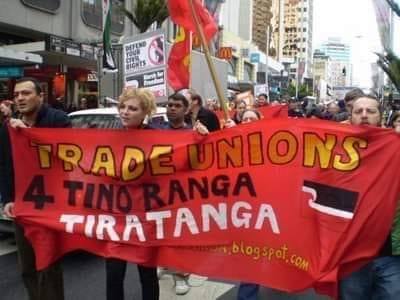


Xavier Walsh, Co-president of Unite union, is a recent Bachelor of Arts (Honours) in Māori Studies and is preparing to start their PhD investigating the potential role of tikanga Māori in our understanding of workplace grievances. In this guest interview, they tell SA why the fight to defend Te Tiriti against attacks from the Right will be Aotearoa’s ‘defining moment’. And why they welcome the notion of solidarity as tangata Tiriti rather than one of ‘ally-ship’ with tangata whenua.
What do you see as the impact of the new government’s ‘review of Treaty principles’ – who will be most affected and how?
The proposals by this new government genuinely affect everyone in this nation. We’ve already had prior attempts to categorise the principles of the ‘Treaty of Waitangi’ – and I make the distinction between The Treaty and Te Tiriti, the Māori version of the text – likely the most famous being the 1987 Lands Case. From the Lands Case, we saw the three Ps (now outmoded) – the three articles interpreted as being related to partnership participation, and protection. But we know this isn’t what the Te Tiriti speaks to. It’s quite ludicrous actually. In contract law, there is the concept ‘contra proferentem’ where, if there is ambiguity in the wording of a contract, the interpretation should go against the interests of the drafting party. Dame Anne Salmond talks about this in a recent Newsroom article*
To add to this, te ao Māori is regulated by tikanga, and tikanga is built on a philosophy that no relationship is beyond repair or redress and that everyone or everything is connected back to the primordial parents, Papatūānuku and Ranginui. Going back to 1840, much of what is in the English text of the Treaty of Waitangi is absurd. Some of the contemporary rhetoric around ‘equal citizenship’ and ‘rights for all’ inherently doesn’t make sense. Māori never ceded their tino rangatiratanga. To say rangatira could somehow transfer or cede it to some foreign Queen Victoria in England is not only absurd, but also illogical and impossible. It’s not a physical object you can give away. Tino rangatiratanga in relation to mana is not something you have; it’s derived from a series of relationships– whakapapa– and divine in origin from atua. It can’t just be given away like a hat rangatira can take off to give to another person. That isn’t what the Māori text of Te Tiriti o Waitangi claims.
And then there is the wording on the paper versus the practice. But what we are seeing in reality is poor outcomes for Māori as the result of Te Tiriti breaches, and even because of NZ’s own colonial empire in the Pacific; so much of our nation’s influence there has meant that Pasifika people in this nation often face the worst outcomes. Just look at the recent Human Rights Commission Pacific Pay Gap report which details this further. What we need to be doing is raising everybody up. It was Russell Bishop who said, ‘what is good for Māori is good for everyone, but what is good for everyone is not necessarily what is good for Māori’. What he meant by that is if you up raise Māori, then everyone improves.
Sorry to invoke Winston Peters, but he’s fond of attacking academics and their attempts to appeal to Māori with their “Treaty of Waitangi gobbledygook” when in fact what ordinary Māori want is decent wages, health access etc. As a trade unionist AND a Māori Studies academic, can you comment on that very simplistic but nonetheless potentially appealing line of argument?
Ah yes, Winston the populist through and through. In 1996 he won all the Māori electorates. Somewhat successfully, I’d say. Did he do it again? No [laughs]. He didn’t have a chance in hell. Māori voters clearly lost faith in him, and they saw right through it all. He is incredibly disingenuous to go in on that idea that you can’t have both Te Tiriti rights and good jobs. That if you have these big academic ideas about what Te Tiriti is, you can’t have jobs and housing. It’s not an either or. I’m thinking of the Matike Mai report [delivered by an independent Maori working group in 2016, it looks at how we can transform the current state for the benefit of all and how to finally honour Te Tiriti] and the whole discussion around constitutional transformation. I think we are going to have more of that discussion now more than ever. There is a sincere need to challenge self-perpetuating myth of white supremacy present in Aotearoa. It’s something we intentionally don’t talk about, but it finds its origins in a Catholic 15th century Doctrine, the Doctrine of Discovery. This Doctrine provided religious authority for Christian empires to invade and subjugate non-Christian lands, peoples, sovereignty, to impose Christianity and claim resources that, frankly, were not theirs. That is the basis for the colonisation of practically everywhere by Europe. Non-Catholics took it in their stride too. England certainly did. This was a religious Doctrine that still plays a part in our lives that we don’t necessarily talk about and it’s from this there that we see systemic challenges of racism and class struggle.
And yes, as a trade unionist, I am trying to build from the bottom up in terms of jobs, housing etc – but we have to talk about both [the history of colonisation and better wages and conditions]. If we leave one without the other, we are never going to get the full picture; we are not going to get a true understanding of the perpetual harm that has been going on for generations. I saw just today the new Minister for Education said she wanted to seek to rebalance the new history curriculum being taught in schools. As though it is unbalanced. What does that mean? If you don’t know your history, how are you to understand the issues going on? Especially in my generation, Gen Z, we see issues like Gaza and we see injustice because our eyes are opened to the historic underpinnings of colonialism in what is a genocide. We have to unpack all of this. It’s wrong to believe that these events only exist in a vacuum. Like the Te Toitū rally on Tuesday. We saw rhetoric around “Okay, Māori are suddenly mad.” No! This doesn’t come out of a vacuum. There is a strong history of Māori protest. How can you [the Government and those who wish to maintain Pākehā systems of oppression] justify the ongoing dispossession of Māori whenua and people, unless you agree that you are somehow superior to Māori?
It’s the same as with Gaza. Looking at Gaza, what happened, yes you can look at October 7th but you must also go back to 1948 and prior to that given Palestine’s history as a British Protectorate. Same as Te Tiriti o Waitangi, you can and must go back to 1840. There is a long history that needs to be unpacked.
Yes it is really hard, getting everyone on the same journey, understanding [Te Tiriti] – we’re all trying to learn to together and it is hard. But so many people are picking up te reo, picking up on different aspects [of Te Tiriti], so to take that away is going to be incredibly difficult. I don’t think the government recognises it will be an uphill battle. There was a great piece in e Tangata**, about the struggle they will have getting public servants to see these changes through. I wouldn’t be surprised if public servants are going to clock in 9-5 and not do those extra hours in good faith, that they are going to stand around the water cooler for that longer moment, that they’re going to be like ‘I am going to take every one of my breaks’, and work solely to meet their outputs and nothing more. Why should they work in good faith with a government that is tearing them and their work down too?
It’s pretty shocking / outrageous that overnight a bunch of right-wingers can come to power and threaten to undo so much progress in the area of indigenous rights. How has this been able to happen? Most important of all, how can we – Māori and non-Māori – resist these changes?
So many of us are now actively identifying as tangata Tiriti. Yes, we are Pākehā, tauiwi etc, but we also we that tangata Tiriti is of itself an identity, a label of sorts. I think it represents that you recognize how you came to be here and your whakapapa. As tangata Tiriti we only have a right to be here as a result of Te Tiriti, as a result of the Crown having that relationship with Māori. And as trade unionists we need to do what trade unionists do best, that is to be in solidarity with Māori and organize around this monumental issue. Actually, it’s bigger than an issue. It’s a fight for our lives, in a sense. It is so big. I am so glad we are moving beyond this liberal idea of ‘allyship’ – it creates an ‘us versus them’ mentality, right? It implies that somehow we are different from Māori, but we are showing up and helping out. No, it is our fight as well. Because as tangata Tiriti, we must be committed to educating ourselves. I recognise that in this day and age it is very hard when you are juggling so many commitments. But if you have time here and there, read that article, watch that clip people are showing around from trusted sources, do those little things but also organise people.
I am so glad we have solidarity because we need to be there together. If Māori are left with this fight on their own, they are going to fail, frankly. We saw with The Voice referendum in Australia that when the rights of minorities are not protected, then the majority rules and then suddenly Indigenous peoples have no rights. How is that right? It’s atrocious. It’s a failure. Democracy does not inherently mean electoralism, that everyone has an equal say and vote. That is just an aspect of democracy. Democracy is representative and the only reason we have democracy in this country is because of Te Tiriti o Waitangi. We genuinely need to start understanding that we as tangata Tiriti need to be in solidary with Māori. We need to raise these voices up, amplify them, organise with Māori for positive change. This is going to be one of the largest protests in our history, it is going to be the Springbok tour of our generation. I truly believe that. It is going to define us as a nation and it is going to put us on the world stage.
Why is it especially important for unions to get involved in the fight for te Tiriti?
The purpose of a union is to collectivise, to improve your working conditions and those of the people around you. The trade union movement for a while became so regressive, so internally focused as a result of neo-liberalism, and it harmed trade unions so much. It still hurts to this day. But if we are to be a movement that people look up to for positive, meaningful change in this country then we need to always be always looking outward to include those who don’t necessarily have the privilege of joining a union at this time. We are a big moving political activist beast that can and must raise up those voices who need to be heard. Those who at times need protecting and to be amplified. As trade unionists, we cannot make change on our own, it is only through our collective efforts that we shall make change together.
This shall be only a one-term government if we make it so. And not only that. If we as a society push the envelope far enough, we can move far further on these issues. We can improve the lot for Māori both in terms of Te Tiriti rights and pushing our understanding of Te Tiriti, and also those ideas around healthcare, housing, education, jobs. We can push all those things together and say ‘enough is enough’ and really change that system that oppresses us all. We can sit on our hands and twiddle our thumbs, or we can really make it hurt. We have to make every single thing the government is trying to do hurt. They want to try repeal smoke free legislation? Make them pay for it. Repeal Fair Pay Agreements? Make them use their maximum political capital so they are so weakened, and so hurt. I want to see a 15-odd National Party after the next election. They should be so scared if they dare to try something like this again.
*Historian Anne Salmond says in this case the drafting party means “those who wrote the English draft of the Treaty and those who translated it into Te Tiriti did so on behalf of the British Crown. In that case, where its meaning is ambiguous, the preferred legal interpretation should be ‘one that acts against the interests of the party who provided the wording,’ while leaning towards those of the rangatira who signed Te Tiriti on behalf of their hapū, and their descendants. There is no chance of a referendum on ‘the principles of the Treaty’ achieving this kind of outcome. First, like so many who have interpreted Te Tiriti in the past, most of those who would vote on the question would be unable to read Te Tiriti o Waitangi in the original. Their understandings of its ‘principles’ would inevitably be shaped by non-Māori understandings of Te Tiriti, and its translations into English, thus breaching the ‘contra proferentem’ rule.”
**https://e-tangata.co.nz/comment-and-analysis/a-culture-war-te-ao-maori-is-ready/
RECOMMENDED ARTICLES

 Socialist Aotearoa
Leave a reply to Patricia Houghton Cancel reply