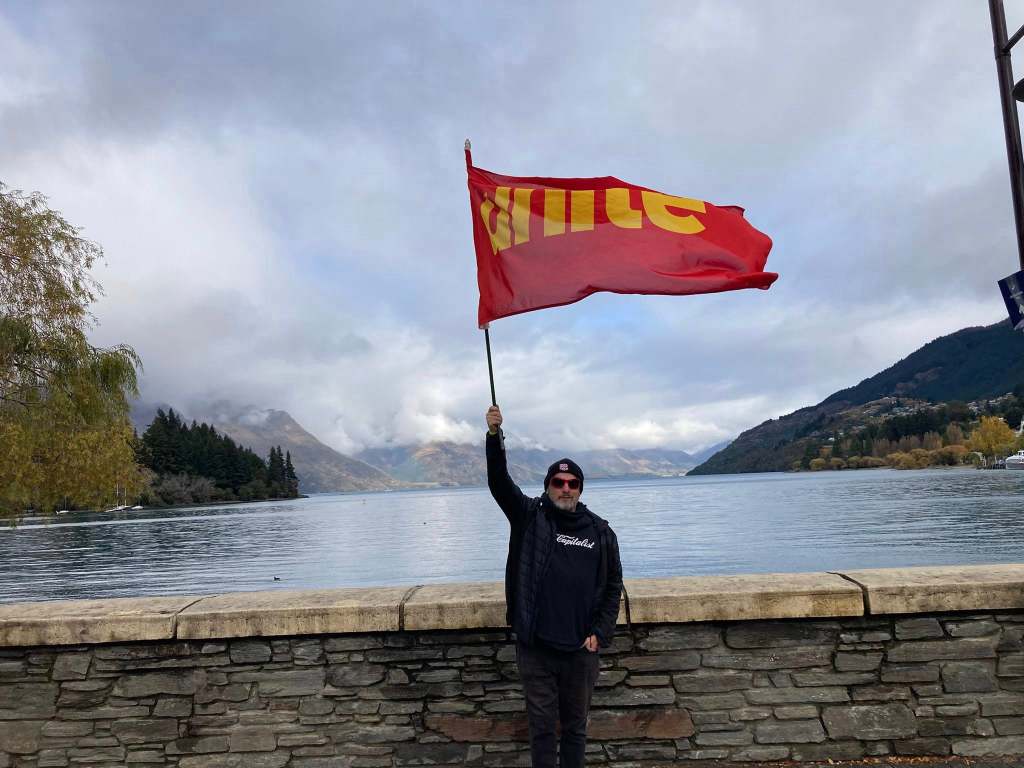


‘What Parliament does, the streets can undo’
Can people power beat back this government’s attacks on workers and beneficiaries? Absolutely, says union organiser and socialist Joe Carolan – but we need union leaders to step up and lead a united resistance. He talks to comrade MH about channeling the rising anger, and the need for a nationwide, women-led ‘pink flu’ day of action
Joe: The budget made people very angry. Particularly when we can see amounts taken off one group and given to another. We’ve seen an increase of $12bn over the next four years for the military and navy, and we see scuppering of 33 pay equity claims that would affect hundreds of thousands of women workers over the same period. We are taking money from health and giving it to the military. We are taking money from low paid workers and giving it to landlords. And that is the anger that is starting to become palpable.
That’s why our slogan is ‘Welfare not Warfare’. Don’t buy new drones and ships and helicopters – build a hospital in Dunedin. That is common sense, right?
MH: There is anger undeniably. But also despair. What do you say to those who feel nothing will change until we vote the Coalition out? Where do you see the hope for an opposition outside Parliament?
It’s in starting to mobilise people power. The hikoi pointed the way for other groups. Particularly the labour movement, which is probably the weakest led of all the social movements in NZ at the moment. The hikoi showed the brown in the coalition against this government. Tens of thousands of people, including tangata Tiriti, many Pākehā and migrants, supported Māori and the Treaty. That has seeped into the workplaces; unionised workers are saying ‘What are we going to do?’. It’s a challenge to the [union] bureaucracy to actually organise protests properly.
The Unions Auckland protest that was organised with only a few days’ notice at Brooke van Velden’s office got about 800 people in a space of a couple of days. So that augurs well for a mass mobilisation, the likes of which we saw in Dunedin – 35,000 people were on that march. We can do this in Auckland but we need a month to build and we need a clear direction from union leaders to turn up. It has to be on a Saturday at 2pm, where most workers can get here. Calling protests with just a couple of days’ notice on a Tuesday at 11am cuts out most workers from being able to attend. So we are organising a Welfare not Warfare public meeting [see details below], then pushing for a large protest. But we want it backed by significant groups like the Greens, CTU, NZNO (New Zealand Nurses Organisation) etc, and that is why we are trying to gather a top table, a united front.
MH: What would you hope a mass protest achieves?
First, mass protest gives people a sense of their own power, that they are not alone and atomised, facing landlords and job losses and the pressures of poverty on their own. That leads people to bring that strength back into their workplaces, into strikes, into the community.
The last time New Zealand faced a relentless neo-liberal attack on this scale, I’d say was in 1991 with the Employment Contracts Act. And at that time the union bureaucracy was forced to organise mass protest. Once they did, then the question of taking industrial action collectively soon came to the fore. As people realised, people power shows we have the strength to defeat the government but we have to use the real strength workers have, which is the ability to stop work.
There are large groups of people at the moment, including women workers, who are able to strike, like the NZNO, doctors, early childhood education workers, PSA members in the public service who face brutal cuts already – what are their unions doing about the 15,000 jobs that have been lost? If all these unions coordinate together we can have a general strike like we did in 1979, which is still to this day the biggest protest that NZ ever had, far bigger than the hikoi. Yet it’s written out of the history books for a very good reason. This is what the ruling class are terrified of. That workers are not just another exploited or oppressed group, but we are actually the source of all the power and all the wealth in society, and if people were to stop work the economy would stop functioning. Leaving the question – who owns the economy? We do. They just suck it dry.
MH: Union leaders are often reluctant to call for mass action – how can socialists and activists help to change that?
One of the arguments union bureaucracy will use in front of mass protest is that they are hamstrung by anti-union laws which have been developed over the past 40 years under neo-liberalism. However there are ways around this, and the ruling class know this too. In the 1990s in Ireland, the police organised an unofficial strike. Police forces in many countries are forbidden to have unions, they did organise a mass strike when they all phoned in and had the flu together. It was called the ‘blue flu’. Women who are disgusted at the attacks on pay equity could all call in sick one day – or week – and we could have the ‘pink flu’ in New Zealand to protest these attacks on women. That could be supported by tens of thousands of people. It would then show what kind of society NZ would be without women workers. What are all the things you take for granted that won’t be there?
In Iceland, women went further. When the banking system collapsed and the government went to bail out the banks and cut back on all the public services people need, it was the women workers who led the women’s strike, which brought the government down. So we don’t need to wait for an election. If you want to bring this government down, organise to stop work!
There was a great slogan the French had: What parliament does, the streets can undo. If all the workers in Auckland stopped work you’d soon find out where the power is in this economy. And these little businessmen in suits would be running around in a panic. Quickly then you’d see billions would be found, huge pay increases, huge investment in public services would suddenly be possible. There are billions of dollars there already. It’s just that they are taking them off hospitals to give to the military, taking it off women workers and giving it to landlords.
Our rulers look like buffoons and bullies – forcing legislation through parliament to escape scrutiny. It’s contempt for the democratic process. But they can be beaten. Before people feel a government can be beaten, that stage of a government losing its credibility has to happen. We are at that stage now.
Welfare Not Warfare – public meeting, Thursday June 26, 7pm. Venue and speaker line-up to follow. Follow us at https://www.facebook.com/socialistaotearoa
 Socialist Aotearoa
Leave a comment