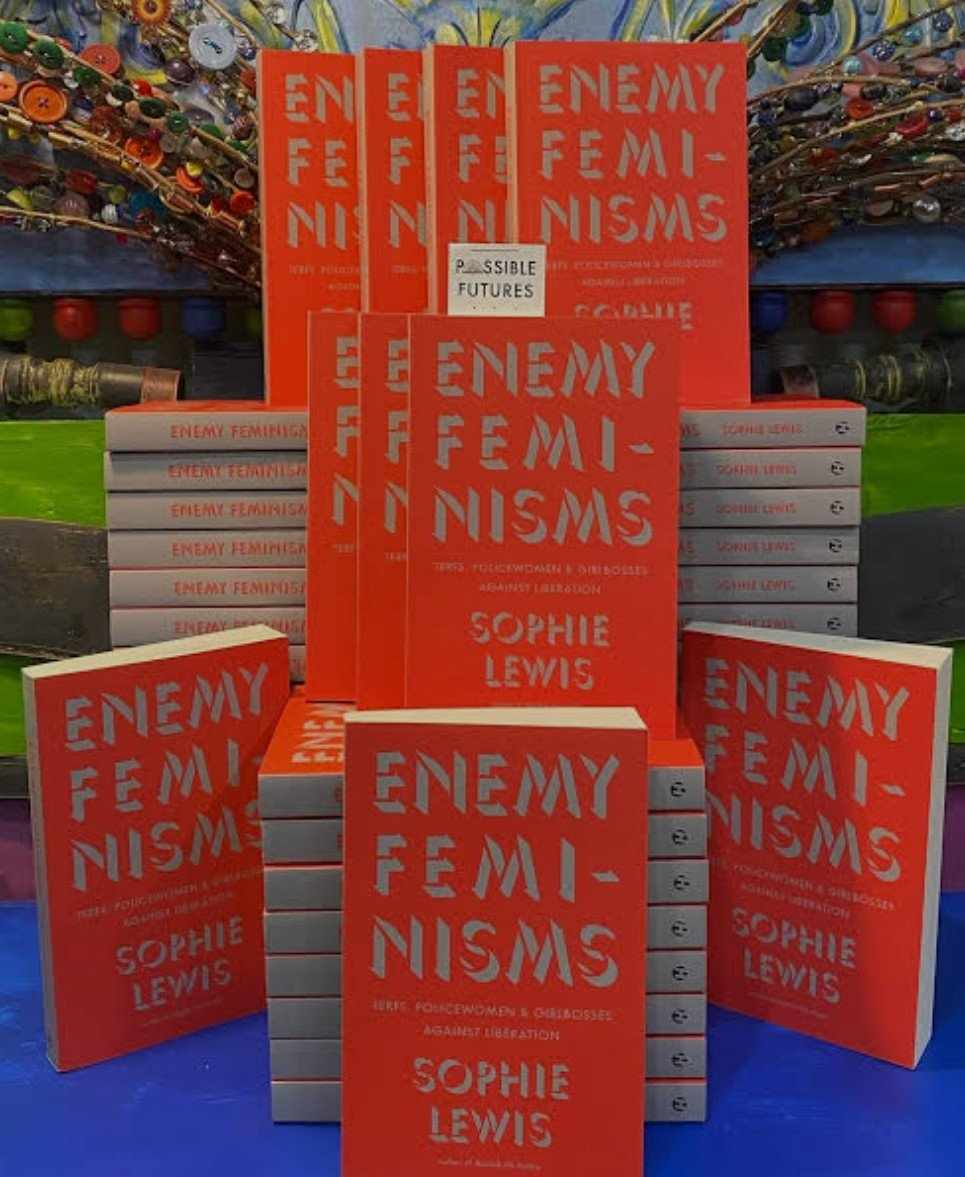


A review by Socialist Aotearoa member Melissa.
Suffragettes from the Women’s Social and Political Union, who expelled socialist members, were fiercely opposed to communism and aimed to build a female police force modelled on the militant German fascist Freikorps gangs are amongst those who are seen as espousing ‘Enemy Feminisms’ by author Sophie Lewis, in her exploration of radical feminist activism. Women’s freedom league suffragists demanded female police training be instated. Mary Allen was described as an ‘unsung hero in policing’ who played a major role in the rise of fascism in the 1920s. There was a strong focus on moral policing. Allen was a fan of British fascist Oswald Mosley. On May Day 1926 Allen used the women’s auxiliary police to help defeat the first ever General Strike, leading to attacks on trade unions and communists. She praised the rise of Hitler.
Abolitionist feminism is a recurring theme in the book, with Lewis advocating for the dismantling of oppressive systems such as the prison-industrial complex and the police state. She argues that true feminist liberation requires the abolition of these institutions, which disproportionately harm marginalized communities. Abolitionist feminism seeks to create alternative systems of justice and community care that prioritize healing and transformative justice.
Fast forwarding to the late 1970s and 1980s we see how the policing of morality by the group Women Against Pornography did not represent the women who were involved in sex work and had no interest in or understanding of what these workers needed in terms of advocacy. Anti-porn feminists would accuse anyone involved in any aspect of sex work or erotica of being perverts and deviant criminals. WAP was oppressively reactionary, stoking moral panic rather than building solidarity. There was huge division in the radical movements in the 1970s and 1980s known as the sex wars. As harmful as these divisions were, I think they were a consequence of the need to find a way to navigate sexuality that was not shaped by patriarchal norms under capitalism.
Sophie Lewis’s “Enemy Feminisms” presents a critical examination of the various strands and conflicts within feminist movements. The book delves into the complexities and contradictions of contemporary feminism, urging readers to rethink established ideologies. One of the central themes in “Enemy Feminisms” is intersectionality. Lewis underscores the importance of inclusivity within feminist movements, arguing that feminism must address the diverse experiences and struggles of all women, particularly those from marginalized communities. By embracing intersectionality, feminism can become a more equitable and powerful force for social change.
Lewis offers a sharp critique of mainstream or liberal feminism, which she argues often prioritizes the concerns of privileged women while neglecting the needs of the most vulnerable. She contends that mainstream feminism tends to focus on issues such as corporate representation and individual empowerment, rather than systemic change and collective liberation. Through this critique, Lewis calls for a more radical and transformative approach to feminist activism. Lewis critiques the capitalist underpinnings of mainstream feminism, arguing that capitalism perpetuates inequality and exploitation. She calls for an anti-capitalist feminist movement that challenges the commodification of women’s bodies and labour. By addressing the root causes of economic injustice, feminists can work towards a more just and equitable society.
Reproductive justice is another key theme in “Enemy Feminisms.” Lewis explores the ways in which reproductive rights and access to healthcare are shaped by intersecting systems of oppression, including racism, economic inequality, and ableism. She advocates for a comprehensive approach to reproductive justice that goes beyond the pro-choice versus pro-life debate, emphasizing the need for accessible, affordable, and culturally competent healthcare for all.
Lewis emphasizes the importance of queer and trans-inclusive feminism, arguing that feminist movements must recognize and celebrate the diversity of gender identities and sexual orientations. She critiques exclusionary practices within some feminist circles and calls for a more expansive and inclusive understanding of gender and sexuality. By embracing queer and trans-inclusive feminism, the movement can better address the unique challenges faced by LGBTQ+ individuals.
In “Enemy Feminisms,” Lewis highlights the significance of solidarity and coalition-building across various social justice movements. She argues that feminism must be interconnected with other struggles for justice, including anti-racism, environmental justice, and labour rights. By building coalitions and working in solidarity with other movements, feminists can create a more unified and powerful force for change.
Decolonizing feminism is another critical theme in “Enemy Feminisms.” Lewis examines the ways in which colonialism and imperialism have shaped contemporary feminist thought and practice. She calls for a decolonial approach to feminism that centres the voices and experiences of Indigenous women and women from the Global South. Decolonizing feminism seeks to dismantle the legacies of colonialism and promote global solidarity.
Throughout the book, Lewis encourages readers to embrace radical imagination as a tool for envisioning and creating a more just and equitable world. She argues that feminist movements must be bold and visionary, willing to challenge the status quo and imagine new possibilities for the future. By cultivating radical imagination, feminists can inspire transformative change and build a better world for all.
“Enemy Feminisms” by Sophie Lewis is a thought-provoking and challenging exploration of contemporary feminist thought. Through her examination of key themes such as intersectionality, reproductive justice, queer and trans-inclusivity, and abolitionist feminism, Lewis urges readers to embrace a more radical and inclusive approach to feminist activism.
Lewis ends on a hopeful note listing the work of those feminists currently seeking to communise care and building underground networks to help those impacted by the ongoing cuts to gender affirming and reproductive care, particularly in the United States. There are growing movements against trans misogyny. Lewis mentions the solidarity at an Auckland rally where thousands of counter protesters prevented anti trans activist Posy Parker from continuing her speaking tour. By addressing the complexities and contradictions within feminism, “Enemy Feminisms” offers a powerful call to action for a more just and equitable future.
 Socialist Aotearoa
Leave a comment