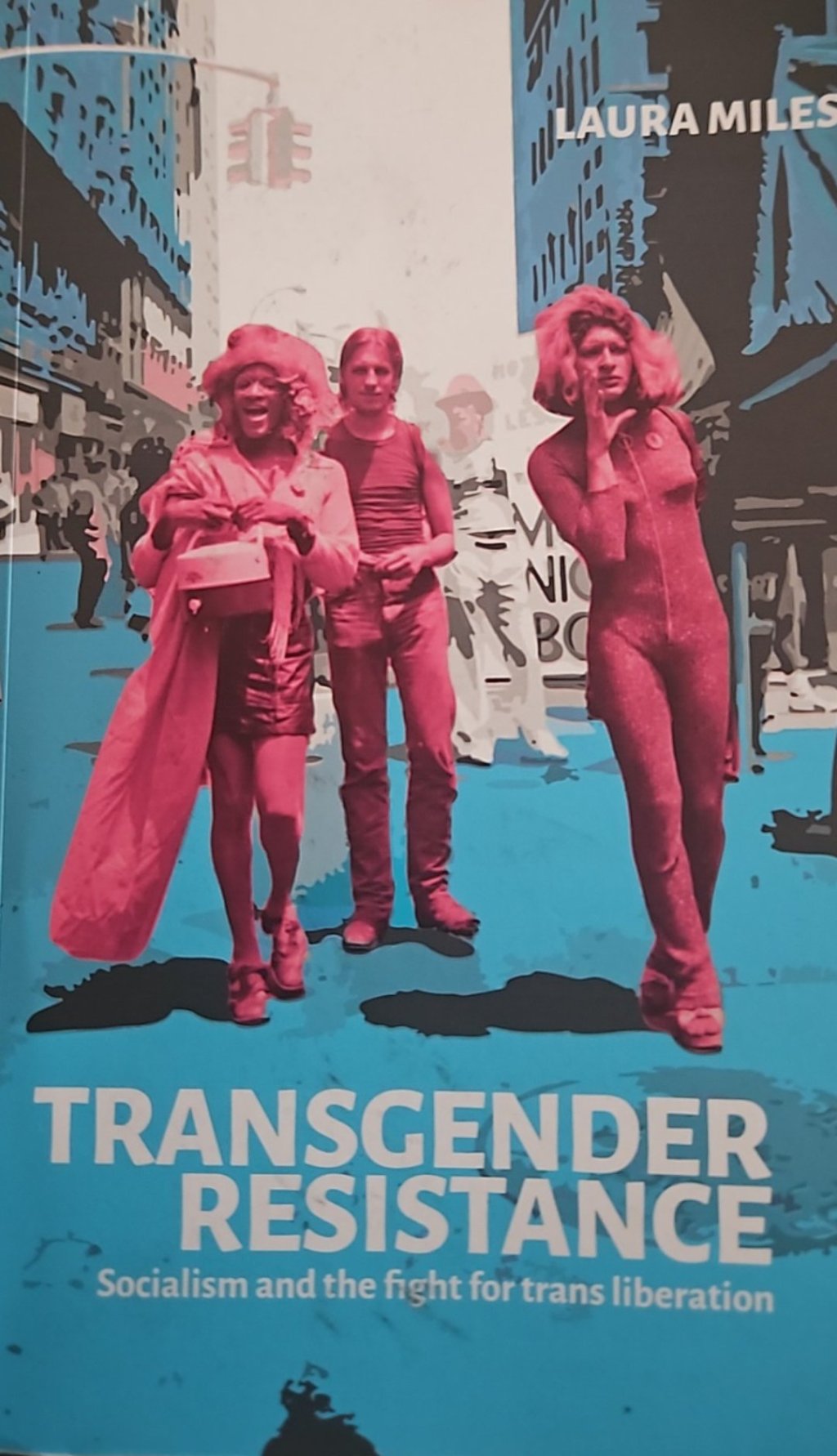


An Insightful Examination of Transgender Struggles and Solidarity, a review by Socialist Aotearoa member Melissa.
Transgender people have always existed but when did transgender oppression begin? “Transgender Resistance” is a compelling and thorough exploration of the historical, social, and political dimensions of transgender struggles. This book gives a clear understanding of why socialism is important to transgender resistance. Miles was the first openly trans person elected to the executive of a British trade union, the University and College Union. As a seasoned activist and academic, she brings her extensive knowledge and firsthand experience to bear in this work in a way that is deeply engaging.
Miles begins by delving into the history of queer and transgender resistance to oppression. When it comes to legislative oppression, Miles writes “we should not underestimate the extent to which the trial of (Oscar) Wilde was a watershed moment in tightening the legal screws on same-sex behaviour in Britain. Wilde had declared himself a libertarian socialist in his 1891 essay, The Soul of Man Under Socialism, which helped contribute to his reputation as a subversive libertine and a danger to the British Victorian establishment both in his politics and in his personal life.”
The exploitation at the heart of class societies has led to the systemic oppression of women in the family, as outlined by Engels in The Origin of the Family, Private Property and the State. This in turn led to the oppression of alternative sexualities and gender expressions. In chapter four of Transgender Resistance the section on LGBT+ rights after the Russian Revolution shows the stark contrast between the cruel pathologisation of homosexuals and transexuals in capitalist societies and the attitude of socialists of the time who advocated for the acceptance of different sexualities and gender expressions. The decriminalisation of homosexuality in Soviet Russia marked a huge step forward for LGBT+ people. These gains were crushed under Stalin in the 1930s. She meticulously chronicles the key events and figures that have shaped the transgender movement, highlighting the often-overlooked contributions of transgender individuals to broader social justice causes. This historical context sets the stage for understanding the contemporary challenges faced by the transgender community. While it was written prior to some of the current backlash internationally against gender diversity and controversy around puberty blockers for example, her discussion of legal and healthcare barriers is illuminating, providing readers with a comprehensive understanding of the systemic obstacles that hinder transgender equality. Miles offers a sobering assessment of the current landscape for transgender individuals. She examines the pervasive discrimination and violence that transgender people face, both at the individual and institutional levels.
One of the strengths of “Transgender Resistance” is its emphasis on intersectionality. Miles examines the interconnectedness of transgender issues with other forms of oppression, such as racism, sexism, and the fundamental basis in class struggle that underpins these oppressions. She argues persuasively that true progress can only be achieved through solidarity and collective action. She demonstrates how alliances with other marginalized groups have been crucial in advancing transgender rights, notably the movement that emerged from the Stonewall riots in 1969. All the key activists were also involved in the civil rights movement, the women’s movement and the peace movement.
The book is not only a critique but also a call to action. Miles provides practical guidance for activists and allies, outlining strategies for effective advocacy and resistance. She highlights the importance of grassroots organizing and the need for sustained effort to achieve lasting change. Her passionate plea for solidarity and collective action resonates throughout the text, inspiring readers to become actively involved in the struggle for transgender rights.
“Transgender Resistance” is an essential read for anyone interested in understanding the complexities of transgender issues and the ongoing fight for equality. Miles’ rigorous scholarship, combined with her personal insights, makes for a powerful and thought-provoking book. It is a testament to the resilience and determination of the transgender community and a reminder of the importance of solidarity in the pursuit of social justice.
Miles has crafted a work that is both intellectually rigorous and emotionally resonant. “Transgender Resistance” stands as a significant contribution to the literature on transgender studies and a valuable resource for transgender people, activists, scholars, and anyone committed to the cause of equality and justice.
 Socialist Aotearoa
Leave a comment