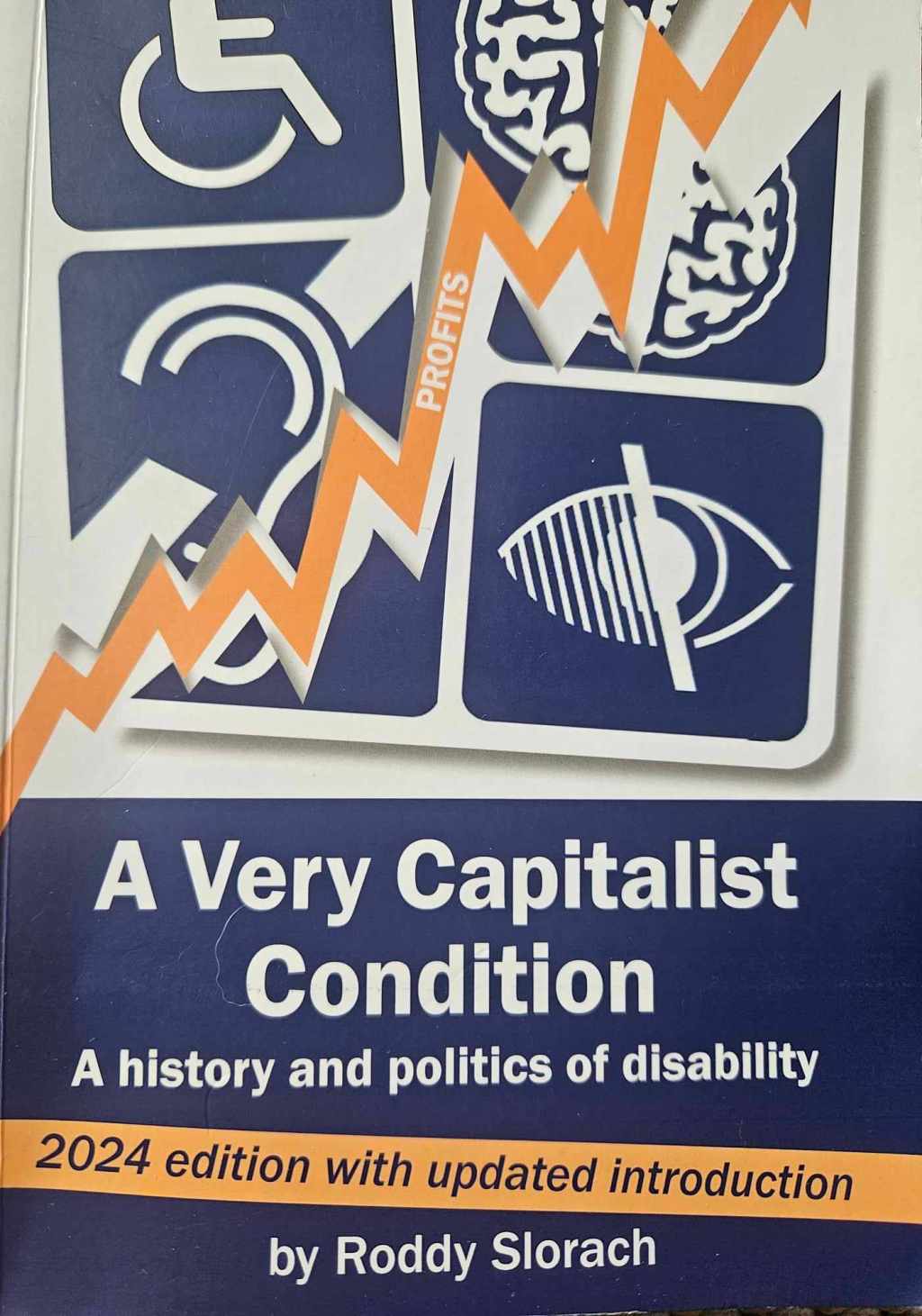


The introduction to the 2024 edition of ‘A Very Capitalist Condition: A History And Politics of Disability’ by Roddy Slorach outlines why capitalism is so harmful for disabled people, followed by a call to action: “All forms of oppression are rooted in a society which forces humans to compete with each other from the nursery to the grave – in exams, jobs, housing and every sphere of life – for the sake of profit. This book shows that disability is a very recent invention in human history. It is a form of discrimination which arose with and is inseparable from a society based on grading and valuing people according to their suitability for profit extraction. The experience of injustice often demoralises its victims. When it leads to resistance however – as shown by the rich history of struggle outlined in these pages- it can rapidly embolden and politicise those who participate. We who wish to save humanity from barbarism must do all we can to fan these flames of resistance, and to fight for a vision of a different world based on interdependence and solidarity.”
This call for solidarity is vital in a movement that can easily get siloed into different groups and can seem to place disabled people in opposition to the carers that exist in interdependence with them. To be united there needs to be a shared vision of the future that we can embrace and work towards.
Marx wrote about the realm of freedom including creative activities such as art, the enrichment of love and friendship, caring for others and hobbies like sport, playing music and reading as part of the full development of each person which should be available to all. However, our access to this realm and our understanding of care are limited by the underlying paradigms of our capitalist society. In moving towards a society based on care we need to acknowledge the ways in which our wellbeing is intrinsically tied to the adequate care and wellbeing of others.
Rather than seeing dependence as being in opposition to independence we can see it in opposition to isolation and alienation from one another. Capitalism has denigrated care and rendered care work largely invisible. We need to build the foundation of our understanding of collective care and wellbeing. Under capitalism, the private nuclear family stands in place of any sense of broader responsibility for the care of one another and our sense of collective solidarity, and respectful care for each other has been gravely diminished. As Margaret Thatcher famously said, “there is no such thing as society, there are individual men and individual women.” The family functions to give free labour to capitalism and to keep an ongoing supply of current and future labourers available for exploitation. Domestic labour, to be made visible, needs to be reformed as essential work. Caregivers are essential workers, and the concept of work is not confined to public workplaces.
The individualised, privatised vision of the ideal nuclear family has been exported worldwide through colonisation, even though it is not an achievable ‘ideal’ for many. In fact, the nuclear family can be an unsafe place, and our relationships can be impacted by market conditions. However, destigmatisation of different living arrangements, including intergenerational families, expands our capacity for care. In modern life, the unravelling of the family can lead to a conflict between on the one hand the broadening of family arrangements and gender roles and on the other the opposing growth of fascist movements which feature the idealizing of powerful males with unrestricted freedom and influence and restrictions on bodily autonomy for women and LGBTQ+ people. The pace of change has led to fear and alienation, which can cause reactionary views to take hold. By creating the conditions which allow for the building of healthy, responsive relationships in which respectful care is highly valued, we can build the society we want based on trust, goodwill and true people power.
 Socialist Aotearoa
Leave a comment