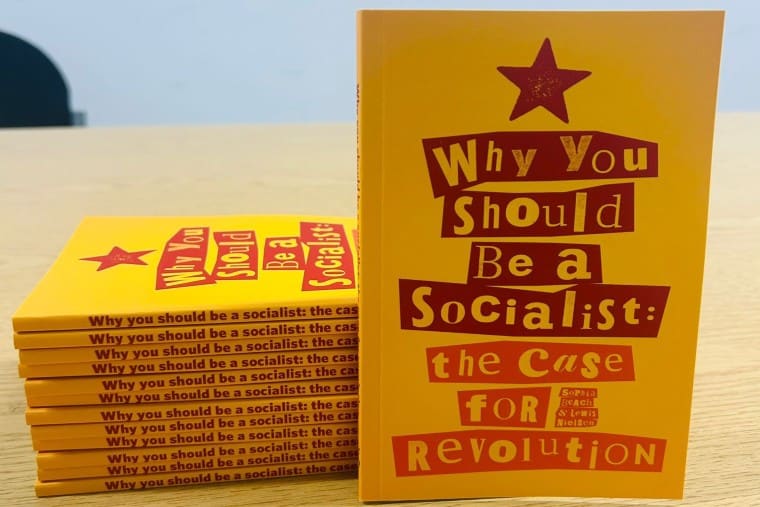


If you would like to get a copy of this book to read, please reach out to us on Facebook or via our email.
“The whole system. Shut it down!” This chant, so familiar to anyone who’s joined a march or rally in recent times, is music to every revolutionary socialist’s ears. Indeed, to anyone who desires a radical alternative to the carnage that is late-stage capitalism. Capitalism isn’t a fixer-upper. It needs to go. As much as we may despise Seven-Homes-Luxon aloft in his ivory tower, or Te Tiriti-bashing Seymour, or rabid Republican Trump, or the genocidal Netanyahu, it isn’t about replacing them with nicer, more well-meaning individuals. The root problem is the system that makes the very existence of these people possible.
The need to demolish capitalism in its entirety, and the mechanism for doing so, is the core theme of Why You Should be A Socialist: The Case for Revolution, written by two leading members of the Socialist Workers Party in the UK. The very fact you are reading this review suggests you’re on board with the ‘why’. But just in case you needed a reminder, Why You Should be A Socialist lays out capitalism’s lengthy rap sheet –racism, transphobia, homophobia, war, women’s oppression, poverty, hunger, the destruction of the very earth we inhabit and more. It looks at why so-called ‘natural’ traits like selfishness and greed along with ingrained sexism, widespread LGBT+ oppression and racial prejudice are all shaped by the capitalist society we live in. These things are not a given of human nature.
Crucially, the book identifies the working class as key to achieving a radically different society, one that puts people before profit. Because despite everything we are told, wealth is not created by the ‘genius’ of the world’s Elon Musks or the investment of the millionaires who our governments are terrified to tax in case they flee the country. It is the working class who create the profits, and without their labour the system would collapse. Workers hold immense potential power. The ruling classes know this, which is why they are at pains to tell us the notion of working class is outdated. They bend over backwards to make the high school teacher who can’t afford a home feel at one with the big business owner who owns several.
Reformist parties are complicit in this. Even though it’s laughable now that we ever had hope in Tony Blair’s Labour Party, for socialists – including me, living in London at the time – it seemed like a welcome release after years of Tory rule. Yet it wasn’t long before Blair stated his mission as creating “A middle class that will include millions of people who traditionally may see themselves as working class, but whose ambitions are far broader than those of their parents and grandparents.”
Working class is not about self-perception. It’s not about the coffee machine you own, or the postcode you live in. Like it or not, it’s about your relationship to what you produce. If you have to sell your labour to survive, you are working-class. And when workers realise they are both the exploited and the key to ending exploitation, when they embrace their power and unite… the consequences shake the system to its core.
Of course throughout history the downtrodden have risen up against their oppressors, for example the slave uprisings in Ancient Rome and the peasant revolts of the Middle Ages. But unlike the industrial working class, these movements were not sufficiently sizeable, educated, equipped or connected to bring about lasting societal change.
“All previous movements were movements of minorities in the interests of minorities. The proletarian movement is the self-conscious independent movement of the immense majority in the interests of the immense majority,” wrote Karl Marx almost 200 years ago. While words like ‘proletarian’ may make these words seem old-fashioned, they’re as relevant today as when he wrote them in his Communist Manifesto.
All this is well and good – but doesn’t the failure of previous attempts by the working class to take power prove that the socialist dream is just that – a fantasy? It’s a fair point to raise. What history has given us, however, is temporary glimpses of what is possible when workers do unite to challenge the status quo. Far from the ugliness, wanton violence and chaos often associated with the word ‘revolution’, quite the opposite has been true. Immediately after the Russian Revolution of 1917, abortion and divorce were legalized, homosexuality was decriminalized, and communal kitchens and laundries were set up to relieve women of their domestic burdens among other progressive measures. But you don’t have to go that far back for a snapshot of how radically and beautifully different society could be. During the Egyptian Revolution in 2011 harassment of women disappeared, and tensions between Christian Copts and Muslims – stoked as a divide-and-rule tactic by the regime – were replaced by acts of solidarity. The groups took turns protecting each other at prayers against attacks by the police and pro-regime gangs.
So why didn’t these gains last? Why haven’t workers united to overthrow a system that is so clearly against their interests? These questions are too important to be glossed over. Why You Should Be A Socialist addresses these and other legitimate doubts such as ‘Is the system too powerful to overthrow? Will every significant challenge to the system morph, as the 1917 Russian Revolution tragically did, into a grotesque travesty – a monster that murdered and invaded and stomped its way around the world proclaiming ‘My name is Communism’?
And here we come to the crux of Why You Should Be a Socialist. It argues that the reason why the Russian Revolution ultimately failed is because, as Trotsky and Lenin identified, its success relied on the domino effect of revolution around the globe. This did indeed happen – in countries like Poland, Hungary, Italy, Spain, Germany and even Britain, workers were inspired by the events of 1917 and rose up against the mass slaughter of World War I and their own oppression. But in each instance a crucial element was missing: a revolutionary party with sufficient numbers and influence to organize, unite and direct the mass of workers towards an alternative and sustainable system based on need, not profit.
Why You Should be a Socialist is an unashamed recruitment tool, its mission to persuade readers of the need to join a revolutionary party. It offers a succinct and cohesive overview of what is wrong with the current system and why an alternative society is not a pipe dream. It investigates the meatiest of topics: Is human nature a barrier to socialism? Why can’t we just elect socialists to parliament? (spoiler alert; you can but they’ll be ineffective – because true power lies in the unelected agents of capitalism: media, police, courts, civil service, army, big business); what would a true socialist society look like? How can we get workers who are currently racist, sexist etc to see their true interests and unite? And because these questions are so meaty, they merit a lot more chewing over than this 77-page manifesto can allow.
But do you know what? The reason I joined the SWP back in the 1980s was because it wasn’t a bunch of pipe-smoking armchair intellectuals discussing the finer points of the Marxist dialectic and holding weekly book clubs. Yes, there was reading and plenty of debate, but much of the time it was action. You can’t wait until the revolution to fight alongside the $7-an-hour migrant sharing a two-bedroom house with 20 others. You can’t wait for the barricades to go up before you confront the right-wing thugs threatening asylum seekers, or the ignorant and self-interested trampling on indigenous rights. You can’t postpone the fight for what is fair. I was proud to be in a movement that was at the forefront of fighting neo-Nazi thuggery in London’s east end, at showing solidarity with refugees and immigrants, at fighting the injustice of the poll tax, at calling out and resisting oppression wherever it reared its hideous head. And like I said, action doesn’t preclude digging deeper into those meaty questions. Debate and activism go hand in hand.
So my recommendation is that you read Why You Should be A Socialist – then seek out further books and dive deeper. But mostly I’d suggest you head along to socialist public meetings and debate with real live socialists. Join a union, attend a rally against benefit cuts, wave a flag on a march for Gaza. Because the more of us who unite in the face of injustice, who defy the system’s imperative to divide and rule, the more chance we have of turning ‘The whole system, Shut it down’ from rallying cry to reality.
 Socialist Aotearoa
Leave a comment