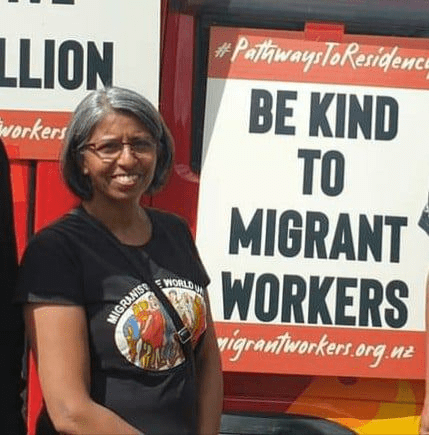


Socialist Aotearoa talks to Anu Kaloti, an immigration adviser with Migrant Workers Association, about injustices in the visa system. Anu, a socialist and long-time campaigner for migrant rights, explains why the accredited employer work visa essentially keeps employees in ‘bondage’, and what Kiwi workers can do to show solidarity with exploited migrants.
Can you explain what the Accredited Employer Work Visa is, and why it leaves migrants so open to exploitation?
As of the past nearly two years, New Zealand has had this Accredited Employer Work Visa category. The employer is given the all-clear by Immigration NZ, the job is checked and approved by Immigration and the migrant worker applies for the visa. The visa always has the job title and pay rate written into it so the migrant can only work for that one employer in that particular job – so it’s real bondage. Before this visa category, we had a couple of others over the past decade or so that were very similar. There has always been bondage.
The greedy employers who want to get rich fast without doing much (I suppose that is most capitalists, but some are in more of a race than others), their way of exploiting migrant workers is by taking tens of thousands of dollars from them to offer them the job and to give them support with their visa application. I was contacted minutes before speaking to you and someone was being charged $50,000 to work in a restaurant. They can’t recoup that money because after about two or three months there is no job. The employers are getting the money. There are many other parties too that take their cut, lots of middle agents.
One company we are dealing with right now is SEAL Security Ltd. Almost a year ago when we had the floods in Auckland, a kind soul in Piha saw some young Indian security guards standing out in torrential rain without much protective equipment, and no toilets nearby. He reached out to ask if they were okay, and invited them into his home to change into dry clothes and have a hot drink and feed them. That’s when they opened up to him, telling him how they had paid 10s of thousands of dollars to an agent indirectly connected to the employer here. How they were not being given enough work. In their contract they have 30-35 hours and there is a pay rate, a median wage which is 29.66 cents. The employment law in NZ stipulates that they must be paid according to their contract whether or not there is work available. So these workers had been grossly underpaid and made to work in unsafe conditions. So this man, Gavin from Piha, took it upon himself to help this group of workers. A couple of them joined Etu union and were able to get their minimum entitlements and unpaid wages because the union intervened. It was quite an uphill task to get them to join the union. It’s the union’s policy not to take workers with ‘pre-existing conditions’ – or words to that effect. But Gavin worked really hard and got the organiser at Etu to come round and represent the workers.
Part of the threat from the bosses is ‘We will get your visas cancelled if you share this problem with anyone, be that a union or anyone else.’ So there are still 10-12 workers who didn’t join the union at the time, and they are still owed wages and holiday pay. On Xmas Day the workers were told they were no longer needed; the boss said he wasn’t getting enough business because these workers hadn’t performed well. And because they had been badmouthing him and the company he wasn’t getting enough work so he was terminating their employment.
These workers took to media a week ago (end January). We are protesting outside their employer’s premises on 3 February in solidarity, and we have also reached out to the Immigration Minister Erica Stanford to discuss with her what we’re seeing on the ground with the Accredited Employer Work Visa. We have reached out to her twice for a meeting and have not heard back [as of February 1].
She was interviewed when the SEAL Security story aired and on record she has said she expects to see a full investigation and expects there could be some law changes. Also if these workers were to apply for the Exploitation Protection Work Visa, they will get it. Among hundreds of exploited workers I have represented as an immigration adviser, not one has been declined the exploited workers’ visa.
Wait, there’s a visa specifically for exploited workers?
Yes. If a migrant who is on a visa attached to an employer have been exploited, they have the provision of making a complaint to Ministry of Business Innovation and Employment (MBIE). They investigate the complaint – which they do fairly fast, within a week or so – and they issue a brief report for the workers saying ‘yes, we believe you have been exploited’. Using that report, the worker can apply for a six-month open work visa. On an accredited work visa, they are usually on a two-three year visa tied to the employer. There is understandably a mental barrier with the migrant workers; they see it as too much of a trade-off. They have paid tens of thousands for a three-year work visa and now suddenly they are going to be left with only six months. But we keep trying to empower them, saying ‘this is 6 months of freedom – you can go and work in any job for any employer. As long as you are paid the legal minimum wage, you don’t have to make the shortfall of your wages as you were in your exploitation.’ More and more workers are taking that provision. We see some who are confident enough to go and make the complaint themselves, but many need a lot of help making the complaint; that’s part of the work we do.
What have recent governments done, if anything, to stop this exploitation?
Last year there were about 140 workers living in three or four houses around Auckland in inhumane conditions. That was in the media lot. We, along with other organizations, were supporting them. And there were some changes made to immigration settings. Not huge, just tinkering about the edges. Now if a person on the exploitation visa can’t find a job with an accredited employer they can get another 6 months on the exploitation visa. The person has to prove they have been trying to find work, so they don’t just give them a straight year. Also now, if they are on the exploitation visa and are out of work they can apply to get support for food and shelter from MSD. It’s about $250 a week, about equivalent to jobseeker’s allowance. It’s not huge but better than nothing. That is what the last government brought in – the extension and then the package of support.
However the root cause, the attachment to single employers, still remains. We have been campaigning for the visas not to be tied to employers for at least the past 10 years. None of the governments seem to see through this problem. They are catering too much to the businesses.
They are dealing with the symptoms, via the exploited workers visa, and not the root cause.
So looking at this big-picture, what fundamentally needs to be changed about the way we view immigrants?
Immigrants are viewed as economic units. This country has its migration policy and they try to balance it with the short-term needs of businesses against the long-term needs. So it’s all about economics. There are so many policies that see immigrants as a burden on our society. For example, there are very strict health requirements. So if anyone is trying to put roots down here and become a permanent resident they have to be absolutely fit. Even minor ailments like type 2 diabetes, which is well controlled with medication and lifestyle changes, even that can impact negatively on their ability to settle here. Another one, which is really cruel, is children with developmental disorders or intellectual disabilities – children on the autism spectrum – we have had so many stories in the media where mum and dad can stay but a primary school child can’t because they are on the spectrum. The premise there is that those children will be a burden on our public education system and our public health system. As with people with minor medical conditions, they will be a ‘burden’.
People are being equated to money. As socialists, that is not how we see people’s worth. As workers we produce the material wealth of this world so that is priceless; you can’t put a price tag on a worker as far as I am concerned. But even if you were to analyse the situation based on economics, the policymakers seem to forget that these very migrants contribute to the economy. For example, builders. There is this narrative that migrants are taking all the houses. They seem to forget most of the construction site workers are migrants. They help to build houses they can’t afford to live in! That is the problem. They need to take the economics out of it and look at human beings. Would the government of this country treat its citizens the way they treat migrant workers? Although actually in some cases they are just as brutal! Look at the cost of living crisis, and housing. That is not because of migrants coming in; it’s because governments over decades have neglected to invest in our infrastructure. It’s like our Treasury has to remain in surplus – why?
Chloe Swarbrick said a budget is a statement of a government’s values… You might say immigration policy is a stark representation of a government’s values?
Absolutely. And there’s racism. We have a number of visa waiver countries, mostly European, where people can come in to visit for three or six months. If you happen to be from the UK, you can come without any visa! Yet if you are from an African or Asian country there are so many hoops to jump through if you just want to come in for a few days, grandparents visiting grandchildren etc. So there is racism as well.
So while some migrant workers are joining unions, many still feel very vulnerable. What can ordinary workers do to show support and solidarity and to help them win better pay and conditions?
In the past we’ve had known franchises or chains exploiting their workers, e.g. there were so many liquor shops where exploitation was rampant – so people can boycott. And if you go to a restaurant or takeaway place and you see a migrant worker, start a conversation with them to find out how they are doing. If you suspect there is some wrongdoing there are many ways to help. You could get media involved, you could get your union involved, do some research online to find out which union represents that sector and inform them. There are workers associations like ours, the Migrant Workers Association, and Citizens Advice Bureaus have been helping these workers a lot too. Knock on the door of your local MP – they have the power to make better policies for an equitable society. Because the workers on temporary visas don’t have the right to vote. That is how most politicians tend to view people – are they a vote or not? So people who do have the power to vote, they need to be up in arms about the treatment of our migrant workers. There is a great responsibility on the voters to hold our politicians to account.
 Socialist Aotearoa
Leave a comment