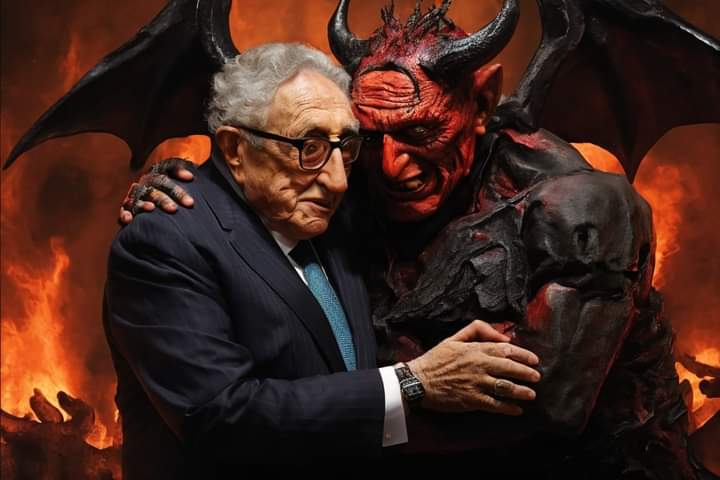


Henry Kissinger is finally dead. In this obituary, Doug R surveys some investigative reporting on some of Kissinger’s many war crimes from Vietnam to East Timor.
Henry Kissinger, who finally died last week at the age of 100, was Secretary of State to US Presidents Nixon and Ford. He was one of the twentieth century’s worst war criminals and the architect of some of the US‘s most brutal wars, coups and genocides including in Vietnam, Cambodia, Laos, Bangladesh, Chile, Cyprus and East Timor. Let’s revisit these theatres of violence individually.
Bangladesh
Our journey into Kissinger’s blood-soaked career begins in East Pakistan. Though most Americans today have little recollection or awareness of it,Kissinger is remembered acutely in South Asia for the part he and Nixon played during the bloody period that led to the emergence of the independent nation-state of Bangladesh in 1971. At the time, the state of Pakistan, carved out by the departing British during the partition of India in 1947, existed as a two-winged territory, split in between by a thousand miles of India.
The army generals from West Pakistan, mostly ethnic Punjabis, disdained the ethnic Bengalis from the east of the country. After elections in 1970 yielded a democratic victory for Bengali nationalists, a crisis ensued that culminated in a vicious crackdown by the Pakistani military on East Pakistanis — a campaign that turned into a mass slaughter of minority Hindus, students, dissidents and anyone else in the crosshairs of the army and collaborator-led death squads.
Sydney Schanberg, the New York Times’s South Asia correspondent at the time, described the month-long Pakistani crackdown in March 1971 as “a pogrom on a vast scale” in a land where “vultures grow fat.” Hundreds of thousands of women were raped. Whole villages were razed, and cities depopulated. An exodus of some 10 million refugees fled to India. When all was said and done, hundreds of thousands — and by some estimates, as many as 3 million — were killed, their bodies left to rot in the rice paddies or flushed into the ocean down the region’s many waterways.
The carnage horrified onlookers and hastened an Indian intervention. The White House, though, stood on the side of Pakistan’s generals — clear Cold War allies who also helped facilitate Kissinger’s secret mission to China in April that year.
Cambodia and Laos
Kissinger was also the architect of the covert war on Cambodia and Laos at the time of the Vietnam War that cost the lives of more than 3 million people and continues to traumatise millions more. To this day, people are still dying from the endless land mines supplied by Britain and other US allies. John Pilger, who reported from Cambodia at the time, writes:
What is beyond doubt is that Henry Kissinger and Richard Nixon unleashed an unprecedented aerial savagery — much of it kept secret from the US Congress and people — on a defenseless people. Kissinger should have stood trial with Khieu Samphan and the other Khmer Rouge leaders. What the US did to Cambodia was an epic crime.
Here is an excerpt from another piece by Pilger:
It is highly unlikely Pol Pot would have come to power had President Richard Nixon and his national security adviser, Henry Kissinger, not attacked neutral Cambodia. In 1973, B-52s dropped more bombs on Cambodia’s heartland than were dropped on Japan during the second world war: equivalent to five Hiroshima’s. Files reveal that the CIA was in little doubt of the effect. “[The Khmer Rouge] are using damage caused by B-52 strikes as the main theme of their propaganda,” reported the director of operations on May 2, 1973. “This approach has resulted in the successful recruitment of a number of young men [and] has been effective with refugees.”
Prior to the bombing, the Khmer Rouge had been a Maoist cult without a popular base. The bombing delivered a catalyst. What Nixon and Kissinger began, Pol Pot completed. Kissinger will not be in the dock in Phnom Penh. He is advising President Obama on geopolitics. Neither will Margaret Thatcher, nor a number of her retired ministers and officials who, in secretly supporting the Khmer Rouge after the Vietnamese had expelled them, contributed directly to the third stage of Cambodia’s holocaust.
In 1979, the US and Britain imposed a devastating embargo on stricken Cambodia because its liberators, Vietnam, had come from the wrong side of the cold war. Few Foreign Office campaigns have been as cynical or as brutal. The British demanded that the now defunct Pol Pot regime retain the “right” to represent its victims at the UN and voted with Pol Pot in the agencies of the UN, including the World Health Organisation, thereby preventing it from working in Cambodia. To disguise this outrage, Britain, the US and China, Pol Pot’s main backer, invented a “non communist” coalition in exile that was, in fact, dominated by the Khmer Rouge. In Thailand, the CIA and Defence Intelligence Agency formed direct links with the Khmer Rouge.
In 1983, the Thatcher government sent the SAS to train the “coalition” in landmine technology – in a country more seeded with mines than anywhere except Afghanistan. “I confirm,” Thatcher wrote to opposition leader Neil Kinnock, “that there is no British government involvement of any kind in training, equipping or co-operating with Khmer Rouge forces or those allied to them.” The lie was breathtaking. In 1991, the Major government was forced to admit to parliament that the SAS had been secretly training the “coalition”.
Unless international justice is a farce, those who sided with Pol Pot’s mass murderers ought to be summoned to the court in Phnom Penh: at the very least their names read into infamy’s register.
Chile
In Latin America, Kissinger was the architect of the US-backed military coup in Chile that deposed the democratically elected left reformist government of President Salvador Allende and replaced him with the brutal fascist dictator Augusto Pinochet who murdered thousands of political activists, trade unionists and Allende supporters. Pinochet subsequently plunged the country into a neoliberal economic disaster that left most of Chile’s workers in poverty for the next many decades and from which the country is still recovering. Pinochet’s henchmen were trained at the school of the Americas in the state of Georgia.
On the 40th anniversary of the coup in 2013, Pilger wrote:
The most important anniversary of the year was the 40th anniversary of 11 September 1973 – the crushing of the democratic government of Chile by General Augusto Pinochet and Henry Kissinger, then US secretary of state. The National Security Archive in Washington has posted new documents that reveal much about Kissinger’srole in an atrocity that cost thousands of lives.
In declassified tapes, Kissinger is heard planning with President Richard Nixon the overthrow of President Salvador Allende. They sound like Mafiosi thugs. Kissinger warns that the “model effect” of Allende’s reformist democracy “can be insidious”. He tells CIA director Richard Helms: “We will not let Chile go down the drain”, to which Helms replies: “I am with you.” With the slaughter under way, Kissinger dismisses a warning by his senior officials of the scale of the repression. Secretly, he tells Pinochet, “You did a great service to the West.”
I have known many of Pinochet’s and Kissinger’s victims. Sara De Witt, a student at the time, showed me the place where she was beaten, assaulted and electrocuted. On a wintry day in the suburbs of Santiago, we walked through a former torture centre known as Villa Grimaldi, where hundreds like her suffered terribly and were murdered or “disappeared”.
Understanding Kissinger’s criminality is vital when trying to fathom what the US calls its “foreign policy”. Kissinger remains an influential voice in Washington, admired and consulted by Barack Obama. When Israel, Saudi Arabia, Egypt and Bahrain commit crimes with US collusion and weapons, their impunity and Obama’s hypocrisy are pure Kissinger. Syria must not have chemical weapons, but Israel can have them and use them. Iran must not have a nuclear programme, but Israel can have more nuclear weapons than Britain. This is known as “realism” or realpolitik by Anglo-American academics and think-tanks that claim expertise in “counter-terrorism” and “national security”, which are Orwellian terms meaning the opposite.
Vietnam
Perhaps most infamously, Kissinger was the man behind the endless bombing of Vietnam for two years without any US troops on the ground, resulting in the deaths of 3 million Vietnamese. In this period, the US dropped more bombs on the tiny country of Vietnam than all the bombs dropped in World War Two combined including in Hiroshima and Nagasaki. This was a deliberate tactic that Kissinger espoused known as the Madman theory. Much like the current targeted bombing of civilians in Gaza, this was the idea that deliberately bombing civilian targets would drive opponents to perceive the US as so crazy and ruthless that they would surrender and concede to US demands. They used weapons that were experimental and illegal like agent orange, cluster bombs, napalm and bombs made up of millions of tiny splinters-like pins that were made of a substance not detectable by x-rays
More by Pilger:
Ho Chi Minh’s nationalists had fought 30 years of war first against the French, whose tree-lined boulevards, pink-wash villas and Odeon terraces were the facades of an unrelenting exploitation; then against the Japanese, with whom the French colons duly collaborated; then against the British, who came to take the Japanese surrender and re-armed them so that they could put down the Vietminh and restore the French; then against the Americans; then against Pol Pot’s Khmer Rouge who attacked from the west; then against the Chinese, Pol Pot’s protectors, who attacked from the north. All of them were seen off, at immeasurable cost.
Perhaps five million people died during the Vietnam war, the great majority of them civilians. My own introduction to the war against civilians was at the hospital at Can Tho in the Mekong Delta in 1967. American aircraft had been attacking VC strongholds nearby. This meant villages. “I guess he’s around 10 years old,” said the young American doctor, a volunteer. Before us was a child whose nose and chin had merged, whose eyes apparently could not close and whose skin, once brown, was now red and black and papery, like frayed cloth. I touched him, or her, and the skin stuck to my fingers. “Beats me how these kids live through all that shit out there,” said the doctor. “This one’s been burned with Napalm B. That’s the stuff made from benzene, polystyrene and gasoline. It sticks to the body and is impossible to get off, and either burns the victim to death or suffocates him by using up all the oxygen.” I went back to My Lai, the hamlet where Lieutenant William Calley’s ‘Charlie Company’ massacred more than 200 old men, women and children on March 18, 1968. It took them four hours to kill everyone, and that included a break for lunch which they ate within a few yards of a pile of fresh corpses, mostly women and infants. (There was one American casualty, a sergeant who shot himself in the foot).
East Timor
In 1975, Kissinger gave the green light to Indonesia’s invasion of East Timor, a former Portuguese colony moving towards independence. During a visit to Jakarta, Kissinger and Ford told Indonesian President Suharto, a brutal dictator and close US ally in the Cold War, that they understood his reasons, advising him to get it over and done with quickly. The next day, Suharto moved in with his US-equipped army, killing 200,000 East Timorese over the course of the invasion.
In closing
These are just a handful of Kissinger’s crimes in office. After serving as Secretary of State to Nixon and Ford, Kissinger’s respectability was tarnished by the Watergate scandal but he later served as an advisor to many other US presidents, both Republican and Democrat, including Obama. Anyone wanting to learn more about Kissinger’s involvement in any of these wars might like to read Christopher Hitchen’s The Trial of Henry Kissinger.
Unlike his millions of victims, Kissinger was able to live a full life and die old. Sadly, he never stood trial at the Hague. While a predictable chorus of world leaders will now try to sanitise and rehabilitate Kissinger’s legacy, we hold his death to be a small consolation in a world of ongoing imperialist violence. Our only regret is that it didn’t happen sooner.
 Socialist Aotearoa
Leave a comment