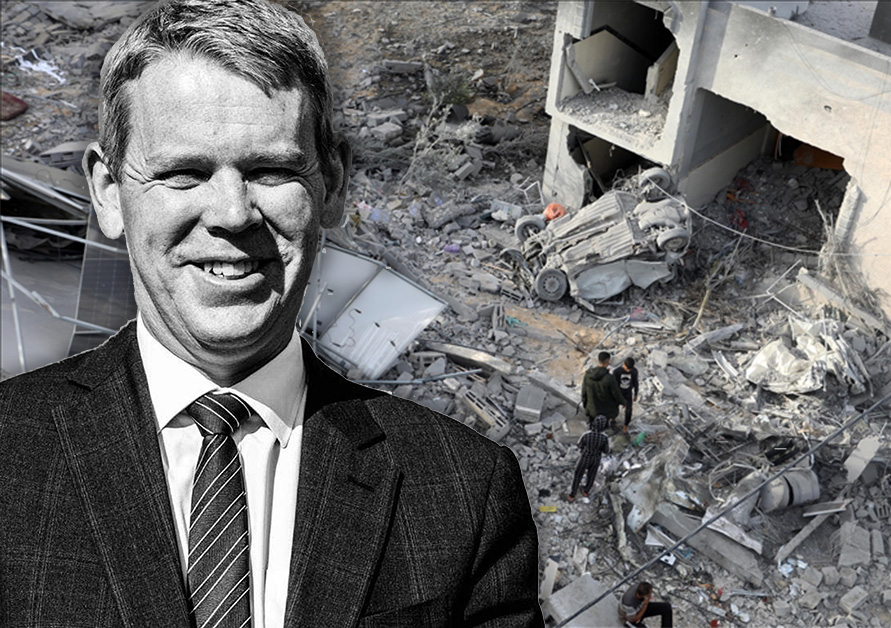


Chris Hipkins’ belated support for a Gaza ceasefire is a sign of the strength of the growing Palestine solidarity movement, but words are cheap without action, we argue in this Socialist Aotearoa statement.
After over a month of mass street mobilisations for Palestine, Chris Hipkins has conceded to pressure from below by calling for a ceasefire in Gaza. This belated change of mind arrives six weeks into Israel’s bombing campaign and ground invasion in Gaza, a genocidal slaughter that has already killed over 11,000 Palestinians. Until now, Labour’s position has been limited to calls for a ‘humanitarian pause’, a cowardly excuse for the continuation of Israel’s militarised mass murder.
Labour’s latest shift on Palestine is too little, too late. Hipkins’ statement has not been accompanied by any specific condemnation of Israel or its atrocities. Nor does it change the position of the caretaker government itself. As UN special rapporteur Francesca Albanese pointed out at a public meeting in Auckland, it does not commit New Zealand to voting differently on Gaza at the UN General Assembly. And New Zealand is still contributing part of its new $5 million humanitarian aid package to Israel, the occupying power in Gaza.
This chip – no pun intended – in the bipartisan wall of silence around Palestine is nonetheless the product of mounting pressure from below. Large and vibrant demonstrations every weekend in over a dozen cities across the country since the beginning of the latest escalation in Gaza have kept the demand for a ceasefire alive. In Auckland alone, these marches have mobilised upwards of 10,000 people, with no sign yet of the movement abating.
There has, as an outgrowth of this concerted Palestine solidarity campaigning, been a palpable shift in popular attitudes towards Gaza. The global call for a ceasefire is now a popular position in Aotearoa, supported by 60% of people recently polled by Talbot Mills. Hipkins follows a host of other parliamentary calls for a ceasefire, including from both the Greens and Te Pāti Māori whose MPs have addressed the Palestine solidarity marches. There were signs of divisions within Labour’s parliamentary ranks over a ceasefire early on, with a scattering of Labour Party figures including Helen Clark and Phil Twyford having already joined the call.
In dragging its heels on the most basic objections to genocide, Labour has now been trailing behind anti-war opinion for weeks. Twyford’s embarrassing speech at a Palestine rally equating the violence of ‘both sides’ in Gaza, a speech that led to him being rightly booed off stage, was an example of Labour’s failure, in the words of the rally MC, to ‘read the room’.
Despite this, and despite Labour’s moribund condition after its electoral defeat, this political shift on Gaza should still be welcomed. It puts the New Zealand Labour Party ahead of its Australian and British counterparts on the question of Gaza (not that this sets the bar high) and breaks this country’s bipartisan consensus over foreign policy that provides diplomatic cover to Israeli terror.
More importantly, Hipkins’ support for a ceasefire may give some confidence to Labour-affiliated unions to speak out on Palestine. Already, there are signs of growing rank-and-file union activism around Palestine. The most recent demonstration for Gaza in Auckland on 18 November was addressed by a New Zealand Nurses Organization member and attended by union contingents from Unite, the Public Service Association and a newly-formed cross-union Aotearoa Healthcare Workers for Palestine group.
The Council of Trade Unions’ 2009 resolution on Palestine demanding an end to the Israeli occupation and supporting the Palestinian call for a Boycotts, Divestments and Sanctions campaign must now be translated into resolutions in affiliate unions and branches. In Australia, such a trade union campaign for Palestine has begun to take shape in a serious way. Unionists including members of the Maritime Union of Australia recently blocked the arrival of vessels from the Israeli-owned ZIM Shipping company at ports in major cities. Members of the Maritime Union of New Zealand, a union that was at the forefront of the South African anti-apartheid movement, have the power to take the same stand now by refusing to handle ZIM ships and Israeli goods.
Statements of support for a ceasefire are not enough – now is the time to implement Boycott, Divestments and Sanctions against Israel. Labour must now put words into action by supporting calls for New Zealand to join the ten countries including Chile and South Africa that have severed diplomatic ties with Israel. Te Pāti Māori’s bold stance calling for the expulsion of the Israeli Ambassador has shown that this can be a popular position. Just last week in Ireland, popular pressure forced the largest parliamentary party, Sinn Féin, to call for the expulsion of the Israeli ambassador, with 58 parliamentarians voting in favor.
Mass protest has unmasked the complicity of New Zealand in a settler-colonial genocide televised before our eyes, funded by the West and openly sanctioned by politicians. We must continue to mobilise and deepen the movement for Palestinian liberation in workplaces and union branches. We have the power to stop this slaughter.
 Socialist Aotearoa
Leave a comment